
Louisiana Orphan Train Museum | Local Leaders The Podcast #211
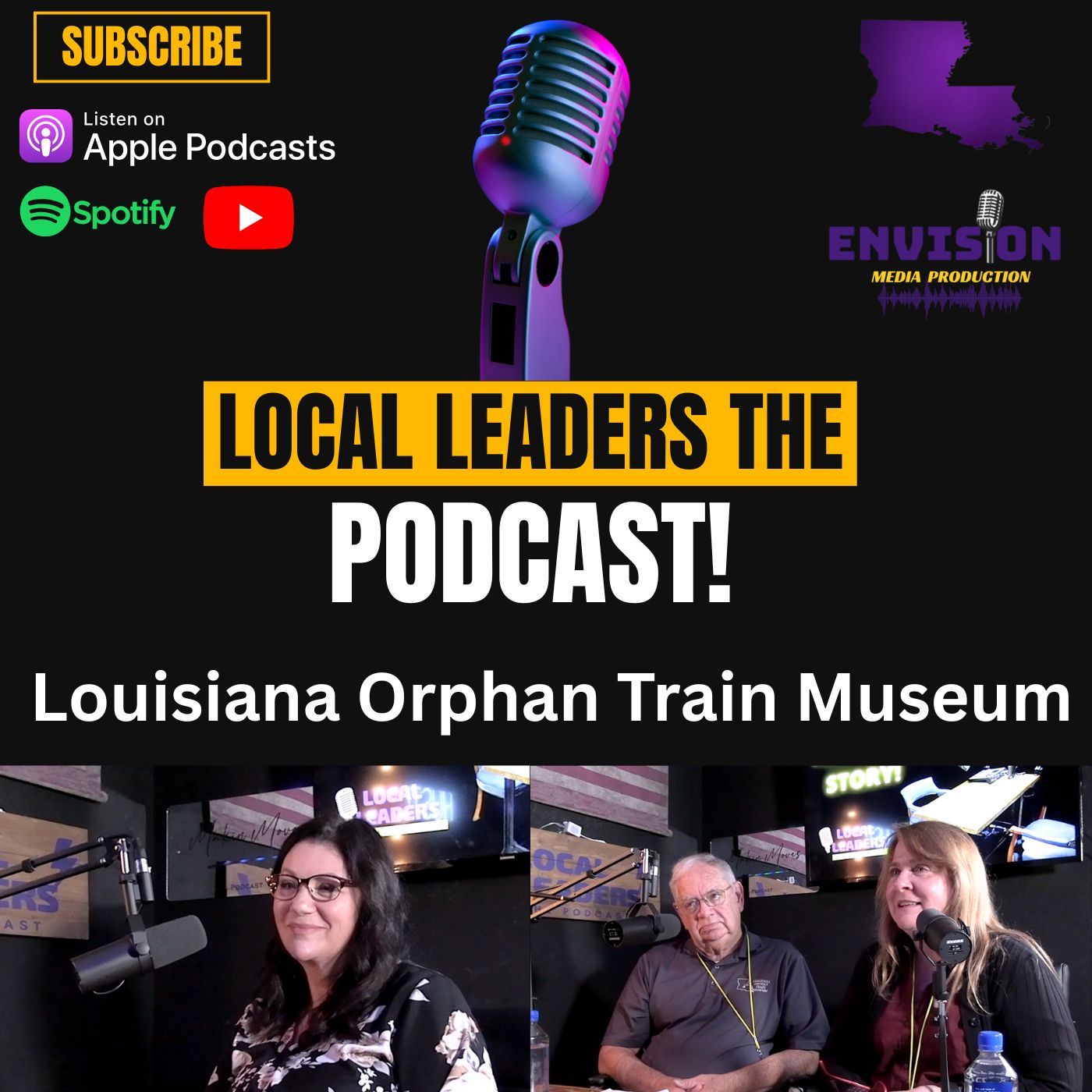
In this episode of Local Leaders the Podcast, Jim Chapman sits down with volunteers of “The Louisiana Orphan Train Museum”. This non-profit museum located in Opelousas, Louisiana highlights the story of children placed on orphan trains from the...

 Apple Podcasts

 Castro

 RSS Feed
In this episode of Local Leaders the Podcast, Jim Chapman sits down with volunteers of “The Louisiana Orphan Train Museum”. This non-profit museum located in Opelousas, Louisiana highlights the story of children placed on orphan trains from the mid-1800’s to early 1900’s with many transported right here in Louisiana.
It’s a deep dive into an often overlooked part of both Louisiana and American History.
You can learn more about the Louisiana Orphan Train Museum via the website below https://www.laorphantrainmuseum.com
Follow them on Facebook here:
https://www.facebook.com/p/Louisiana-Orphan-Train-Museum-100044257255165/
0:00 Hey, everyone, and welcome back to local leaders of the podcast. And look, we do some things around here that cover a wide variety of subjects. Today we have actually three people here, one off camera that's going to be coming on a little later on and tell her story. But for now, I want these two folks across from me to introduce themselves and tell me who they're with. Good morning, Thank you, Jim. And my name is Martha Obert and I am with the Louisiana Orphan Traine Museum and Opelousis and I am the board president of the museum. Very good and you, sir. And my name is James Dogey and I'm also a associated with the Luision Arpin Train Museum and Opolusis. I'm a board member and you help you give tours and so forth.
0:50 I love that. And with those last names, you can't hide that you're from Opelousas. Some good old Cajun names there for you, South Louisiana friend of mine. Today we're going to talk about the Louisiana Orphan Train Museum and I'll tell you what It's been around a little while, but a lot of people may or may not be familiar with it outside of your general areas. So our goal today is to not only make you familiar with it, but we want you to want to go visit that place and get involved in this history. History is so important in all aspects of life, and if you don't discuss it, if you don't talk about it, if you don't put it out there, it will disappear eventually over time.
1:40 So let's talk about what it is for somebody that's never heard about this either one. So you know, agreed that history. We all know Jim gets lost at the kitchen table. It happens in our own families, right. And we also are aware that a lot of people do not know about our museum, or they might have heard of it, but they don't really know what it's even about. So we, by the way, are only one of two Orphan Tray museums in America. There's actually a national I believe there's a national. In Kansas in US. So another charm for Louisiana to educate people in the local area and beyond of the history.
2:29 So this museum has celebrated its fifteenth year last year, and it is the culmination of many many people, our predecessors, you know, had the passion and the drive to get this started through a years and years process of collecting history. Again, if it's not collected, no one will ever know about it. So what we do is we are dedicated to the history of the orphan trains and we dedicate the museum to the Louisiana Orphan train riders. So this history of orphan trains dates back to the mid eighteen hundreds, and you know, basically there was a huge overpopulation of people in New York City. You can imagine way back then, every day there were thousands of immigrants coming to America, leaving their destitute lives that seeking for better opportunities. And when you put thousands and thousands of people together who don't have a lot of means to support themselves of their children, then you have problems. So you have an overpopulation of people nowhere to live, overpopulation of people, no jobs, and you have a lot of diseases and epidemics, and sadly, children were cone at the end of the lawn and were of the most fra They just couldn't take care
4:02 of their children. Maybe the parents got sick and passed away. It was just bad times. But it's our history and so there were two faith based organizations that had visions to help these children. So in the mid eighteen hundreds, which would be eighteen fifty four to be exact, was the first orphan train that went westward. You know, you've got this overpopulation of people with very destitute socioeconomic things going on in New York City, and a lot of people were going westward on trains, and so Charles Lauren Brace, who founded the Children's a Society in eighteen fifty three, thought why not put the kids on trains westward. He believed farming was good spiritually for children. Everybody worked on the farm, even the parents' own children. But he did think these children could be a hand to a family, a help, so guarded sending children westward in eighteen fifty four on orphan trains. They were typically given over by townsfolk who wanted them, and they were given over as indented servants. Our museum focuses on the New York Founding Orphanage.
5:20 It was actually founded in October of eighteen sixty nine by a sister, Mary Irene Fitzgibbon, and she wanted to do something to help all the homeless children in New York city. Thousands of children were left at the New York Foundling. My grandmother was one of them. I am directly descended from a Louisiana orphan train rider, and I knew my grandmother very well. I actually lived with her for seven years in New Orleans. So here you have this culmination of all these peace people in the Oppolusis area and beyond the state who have an interest in this or passion, and we here today want to get the word out like we do every day. It's our mission, part of our mission as a nonprofit and is that we want to inform and educate the public of this historical, untold history. It was very untold, it was stigmatized, and we're there to honor this and inform the public, especially educators.
6:37 Our children are our future. You know, we believe in educating you know, any age group of students, students. We have a lot of students who come to our museum and do projects. We help them. They usually win first or second place. You know, it's not about winning, but we all know it's a great subject. So this orphan trains Sister Irene starts sending. She has thousands of orphans in New York City at the New York Family, she ends up incorporating her orphanage and build the New York Founding Hospital in there. And so what she wanted to do differently from mister Brace was used the Catholic Church to place the children. So she would go on massive correspondence with parish priests and bishops all across America and would ax them to find parents for these children. So when her children left, she knew who they were going to and were they were accounted for, and they were also visited. She was very well respected in New York City, not just by the Catholic population, but very admired by the Jewish population and other denominations. I mean, she was saving lives, thousands of children. I'm just one of thousands of people who have descended from these orphans, and with us trying to get the information out there, excuse me,
8:08 we know that there are many many other people like me. Yeah, and a lot of people that probably don't even realize. Absolutely they don't know because it was so stigmatized and kept quiet. You can imagine. I know my grandmother was not proud of being an orphan, you know, being left at the New York Founding hospital at the age of three weeks old by her mother, and the mother never went back. So with this act of humanity, you know, I exist today because someone took my grandmother in and then she was sent on an orphan train to Terrbone Parish to buy you black Louisiana. And from there she migrated over to New Orleans, where she ended up meeting her husband.
8:53 Wow. And you know, it's almost it was almost a very archaic version of fault foster care, kind of like an early a very early different, but foster care. Absolutely, it was foster care. Yeah, and she was very visionary. Sis Irene Fitzgiven. You know what had happened was she actually had contracted asiatic cholera. She was a teacher in New York City and she was actually in a koma dying and she heard people planning her funeral and her story is published, you can look it up. And she had a vision of children. So she felt like God was speaking to her and she promised God, if he would let her live, she would dedicate the rest of her life to children. So she survives. She joins the Sisters of Charity of New York. It was a very well respected Order of sisters at the time, and she told her mother, superior mother Eily, what happened to her.
9:53 She said, I want to start an orphanage. Well, they knew they needed to do something. It was bad situation in New York City. So you know, that's how her journey began. Very interesting. And look, New York City very small, I mean not a large you know, it ain't the size of Texas. We've all seen a map, and so you've got all this influx of children, and so it does make sense what the goal was there. Mister James, I'm gonna turn to you for a minute and what I want to ask you. We talked a little bit off camera and you told me an interesting story about you having a family connection to the orphan trains as well.
10:38 That's right, Jim. And one thing I like to say is comments from visitors to the Lesion Orp and Train Museum in Opolis is one of the most common comments is you guys are so so passionate. And the reason being is because we have a vested interest. Most of us that that kept tours and talk about the story have a relative that was a New York carpet. In my case, it was a little bit different. The vast majority they were on the trains, they were by themselves. In my case, the fast story goes that my grandparents heard Father John Ingbrink, the local pastor at Saint Andree Catholic Church, gave his sales pitch, and by the way, all these priests in South Louisiana they.
11:26 Heard the call. They heard how sister was trying to place these youngsters, and they agreed. And by the way they investigate, they went up to New York, many of them, and they were so impressed with the way things were being run that they came back down and they talked to their congregations and tried to recruit foster parents. Well, in my case, my grandparents at the time had no children of their own. And the family story is my grandfather and grandmother went home, they started talking it over, and my grandmother warned a little girl. My grandfather warned a little boy. You have to understand, they were placed ahead of time. They were pre ordered, so to speak. Sure, and they couldn't decide, so said, well, let's take one of beach, all right.
12:16 And they weren't biologically related. They were only four months apart and age, different last names, and so forth, and then the rest of the story is about a year later, my dad comes along and the rest of the siblings, and so they ended up with seven of their own and two of the orphans. Growing up as a young person, I knew nothing about this. I didn't know the little boy because unfortunately he was killed in a hunting accident at the age of twelve. The girl which became my aunt, I always knew something was different about her, you know, she looked differently, she certainly had a different accent, and so forth. I was married before I found out she was Louise come down own the Arpent Trains, and since then I've took a big interest in the story. As a former educator, I taught several years of losing history and so forth. We have a lot of kids who come on field trips, and one thing we hear all the time is that sometimes the foster parents would take these kids because they wanted extra workers. There's a lot of misconceptions about the movement, and we tell the kids you have to you can't judge people over one hundred years ago with today's eyes. The things that were done at that time were completely different today completely what's going to happen fifty years from now when people looking at our society in the present. But anyway, I would tell
13:47 the kids, you know, they would treat just like their own kids. They actually had to work, you know the kids that they think, oh, they just went extra workers. No, everyone worked in those days, right. There was no going off into the bedroom when he so phone and so forth. That's one of the big misconceptions. Another misconception is that all these kids were adopted. The vast majority were not. Once again, you have to understand the way things were over one hundred years ago. They were placed with these foster parents. They were checked on at least twice a year. Some agents would come from New Orleans. Sometimes nuns would check on them and so forth. And you better believe that local priests they were keeping an eye out on those kids. Because their reputation, they had to recommend the foster parents. So but many cases the foster parents could not.
14:45 They had very little education. In my family's case, they only had like third fourth great education. And if they signed any kind of papers at all, in their mind they were adopting. Of course, the expense of going to get a lawyer and go into the court, everything involved in my case. I know my grandparents. I'm certain they loved the two orphans they took in and in their mind they they had adopted them. But that caused problems when those kids would become adults under Louisiana law in most state laws as far as inheritance would come along.
15:26 So you did cause problems later on, but it wasn't because they did not want to take these kids in. Well, one thing, says Irene, I definitely want to make this clear too. The last thing she wanted the children to appear as was orphans and. Even back then that even back then. So and what's really beautiful at the museum is we have quite a bit of the original clothing the children had on when they were hands over to the families. Wow. And what's interesting too, Jim, is they all have the original tags. Well some of them have the original tags on them.
16:09 That's really cool. It is really cool. And so you know, we're very proud of that in the museum because the families haven't trusted us. But they were given over as indentured servants as well. They all had indenture papers and that was how it was done at the time. Just like James said, look at the time, and that's how things were done. And let me ask you this quickly, you know at some point and we'll fast forward a little bit here, because this museum just celebrated fifteen years. Congratulations for that. But that also tells me that prior to fifteen years ago, there was no Louisiana Orphan Training Museum, at least in Louisiana.
16:56 You only have two throughout the country. It was thorn on the FLOE's bed. Yes, the museum, the Collection of history. So how did that start? How did this come about? So? Yes? So by the way, our historian of our board is ninety seven years old. Oh wow, so interesting to note though. It's very unique and I do believe God always has his hand and everything. So flow In hern her husband's father, so flow In her is Awa historian, and her father in law came on the orphan train, her husband's father. And the unique thing about flow In her father in law is they actually formed a relationship where he actually would talk about it with her, the experience of being an orphan. That is not very common.
17:52 A lot of them were very hushed up about it and never spoke about it. But he actually talked to her over many many cups of coffee about it. So that was a unique thing right there, that that relationship formed in that manner. So he would talk about other orphans that came to the area. Now, one thing, we want all the listeners to know. They went all over the state of Louisiana. They went all over, especially New Orleans. But historically they did go top Lusis in nineteen oh seven, three trains in the spring. So anyway, he would talk about these other orphans. So she started collecting history. She would get in touch with at that time some of them were still alive and she would say, you know, we're starting to collect history information, oral history, artifacts. We want to have a vision of starting a museum. Years and years went by with her doing all this and the committee they formed a committee. So as you start collect history, then you have something to show. So then, with God's grace and all the efforts of multitudes of people, the museum opened in two thousand and nine and we were able to put up stuff, artifacts, photos, and collecting clothing.
19:20 Interesting thing about the clothing, not everyone has the clothing. You can imagine it was tucked away. My grandmother hid hers in a cedar chest in her shotgun home on Opelousi's Avenue in Algia's Point, and so you know, they were very tucked away in various shames. But some of the families still have the clothing. So we're really proud of our clothing in the museum. Everyone who comes to the museum gets an oral guided tour. We're oral history. We incorporated all because we know so many of the families. So it started with a vision of a committee formed, and then from that many just did They didn't give up.
20:02 Yeah, and they didn't give up. That's exactly what it takes a lot of times for this type of thing. I'd just like to mention too, Jim, that a lot of visitors, especially to young people, they have that misconception that the moms who gave these children up did not want the child. Totally wrong, totally wrong. They were desperate, They couldn't even take care of themselves, much less of newborn and so forth, and they always wondered whatever happened to that child that they gave up, did they survive, did they make it. And so forth. And I'm quick to point out to the young people who look at the pictures on the wall, guess what the vast majority of those people would have not survived if that mother had not given up the child for a better life. Yeah, and in many cases life itself.
20:56 So we went to make that clear. Did they have abuses, of course they did, of course they but they had a lot of safeguards. They were constantly being checked own by agents or nuns visiting the kids were in many cases they were extremely afraid when an agent or a nun would come to check on them, because many times they were afraid, they would take the child back. And in some cases I'll let Marpha maybe mention them one story in particular about it that actually happened in more than one occasion. Yes, it's very true. Which when I envision that these children were visited, so this is after nineteen oh seven the children are placed or in that era, sure, early nineteen hundreds, the trains were in the later eighteen hundreds as well. They have to come and visit the children.
21:56 They have to go physically out to where the farm is or the the home, the business. They went to, farmers, they went to they went all over and to check on the child. And so you know, you can the multitude of this. Task, huge undertaking I mean, none of the conveniences you have in today's life to do that. There was no internet, email. You know, anyway. So but that's what's so dear to the families is that they know that their orphan was checked on and typically the indenture papers. And I did want to mention this. The sisters usually typically would not do the indenture paper immediately, and I never understood that till as you go, was always researching it was in the child's best interest that it wasn't signed immediately because they wanted to make sure it was going to work out with the fall to parents. Wow, I'm telling you they were protecting the child. Yes, and I believe the untold history part of it, and yes, the stigma, But at the same time, I really believe in my heart the sisters were trying to protect the child as much as they could. And I think that's why there's just not a lot of information out there.
23:23 I would agree, And you know, there's probably a lot of people and I'll get into this in a couple of minutes with our next guest that will be coming on, Miss Angie. But in schools, you may be sitting there thinking right now, I never read about this in a textbook. I don't remember seeing anything about this, and chances are you didn't, and that's because it's not taught in the schools. And that's a very passionate fight that Miss Angie is is fighting to try to get that into in fighting. Maybe the wrong adjective there, but she's trying to get this taught in the schools because it's important. It's a part of history. It's no different than any other form or part of history that the United States has been through, and I'm a big proponent and believer that it should be taught. Let's talk real quick. So in the museum, you have artifacts, you have clothing, You even have a beautiful mural in there, done by a pretty famous artist.
24:27 We do. We have a beautiful wall sized mural painted by Robert Dafford and it is titled in Historical Moment in Time, the Orphan Train arrives to Opelousis nineteen oh seven. And it is beautiful. I see it thousands of times, and you don't get tired of looking at it to It's always pretty. I can imagine, and it starts getting more three dimensional with me. I don't know if it's my vision, but anyway, So yeah, we're real proud of our mural. It shows, you know, depict the scene, the heartfelt scene. That's how I want to describe it as the children standing there alone, a lot of them with the adults, you know, there with the sisters. And he did represent the local past priests for the Johnning Gry and so you know, and it's all oral history. So typically what we do when they walk in is Okay, first of all, how much time do you have? I'm glad.
25:30 I'm really grateful to James that he told me one day, He's like, you got to ask them how much time they have because we could talk for hours and they might want fifteen minutes, they might want two hours. Sure, we don't know. And Jim, it's amazing. Adults can always learn from kids. Right Always kids are kids are going to be honest. They will point out they have their filters right right, and they'll point out, okay, why do the kids in the mural look like adults? And we were like, why did he do that? And we think that the artists wanted to depict the children and all the traumasol to speak, that they had been through. You can only imagine being loaded up on a train. Okay, in New York City, you're going to a strange place. In many cases, you're only four years old, three years old, five, maybe even younger.
26:26 And all you're told is we're bringing you to meet you new mamas and papas. They have they've never seen countryside, you know, they're used to concrete sidewalks, streets, buildings, and so forth in New York, and all of a sudden, you're in this strange place and you're getting down to a place where everyone's speaking a different language, a whole nother world. So we think maybe he wanted to depict these kids had seen so much or been through so much. He wanted to, you know, have that effect and so forth. But speaking of the kids to one of the big topic we touch on we have school children is about bullying.
27:08 Bullying is a current popular topic to go into. It's also been around forever. It's been around forever, and we we the human person is always one of the greatest desires is to feel belong. Okay, I feel like you belong with a group. And these kids were coming down to a situation where they might as well have been coming from another planet, you know, everybody's pointing at them and talking about them and so forth. And they went to school with with having all this being said about them, and so they didn't feel like they belonged they were.
27:48 They were very shy, holding their stories inside. Only until these kids became adults and time was was getting away from them did they begin to open up, even to their immediate families. All educators have had children, cases of children in their class who didn't feel like they've blown and so forth. So we try to talk to school kids, Hey, you see that kid in the corner, you know, say hello to it. Make them feel wanted and so forth. We have a little display where we talk about the two little second grade girls sitting side by side. Yes, boys and girls, there was a time when two people sat in the same desk, and it's recess time and all the kids get up and run outside. Okay, Well, Ms Cammi, who was the mother of our historian, it's true story, happens to be sitting there with my aunt Christine, and it's recess time, and Camis says, come on, let's go out and play with the rest of the kids.
28:55 And Christine says, no, I don't want to, and say, why don't you want to go out and play? So I hate to go outside at recess. The kids pick on me, and she started saying that they call her all kind of ugly names because she was different, and she knew she was different because adults would talk at home about the orphans and the kids don't know how to keep themselves quiet. They bring all that to school and we'd pick on the kids. Anyway, as the story goes, Christine put her head down and she started crying. She said, I have no friends. And at that. Point this Caamy puts her arm around Christine and says, I'm going to be your friend. And she was friends whatever for the rest of her life. So we try to teach the kids, you see someone different in the classroom or whatever, be your friend to that person. So there's a lot of lessons that can be learned from from this story.
29:55 And that's. Very relatable. Yeah, it really is. And you know, I would obviously encourage one thing from all the listeners out here, and that is make sure you share this. Sharing is very important with what we do. The more people that have access to see this on if you see a link on Facebook, share that on your on your newsfeed, because it's what it's all about, as many people as possible knowing not only did this exists, but a little bit of the story behind it. You're open Tuesday through Friday, correct, and then Saturday by appointment.
30:38 That is correct. Okay. We do like when we encourage if you're listening and watching us to call ahead. We just want to make sure we can best accommodate you because we do have groups. We have groups scheduled, but you know, you can call the museum at three three seven non four eight two, and we have an email which is La Orphan train In two thousand and nine at gmail dot com. But yep, call us up. We'd love for y'all to come and learn about this untold history, very unique history. It's only one of two Orphan Trae Museums in America. It's right here in Louisiana. I'm so proud of that shit. Yes, and so you know it's a gym.
31:22 And I like to say too that when I was teaching school, kids have that desire to learn about their local histories. You know, we're real good about teaching about American history and world history, but there's so many stories out there that you'd be amazed the interest when when you're talking about someone you mentioned last names. Hey, I might re relate to that person and their ears picked per cup, and they have that desire to learn about They love to hear about their own families, and that's one thing we try. To do well. You're at the gym. We're in a circa nineteen hundred. It's one of the last Union Pacific Freight depot buildings left in the state of Louisiana, and it's beautiful. So uh you know. The interesting thing about that is typically those buildings are bulldozed. They're not ever saved and restored.
32:18 I was was restored, thank god. So uh, you know, we have a beautiful building that the museum's in. I love that, and y'all are doing some phenomenal work. I want I want to thank you for that. Yes, so, And it's just been a pleasure to be able to come and speak of this. And I hope whoever's out there, if you think you know, or you might even be descended from an orphan train rider, or you might have heard your grandparents or your even your parents talk about this. I'm a second generation. I'm a granddaughter of one you know, if there's anybody listening to this, y'all need to call this because you never know, you could be descended from very well could be.
33:01 And the great thing too, Jim, is we've gone from where the original orphans kept everything inside, you know, they felt in some cases ashamed and so forth, to now where we have an activity. We call it a gathering. It's like a little reunion in October. And the grandchildren or the children who are up in age now also they love to put a little ribbons on that says they were descending. Up a newer carpet. Yeah, we've come a long ways in the last several years. I love that. And I'm gonna link tons of links in the description of video, folks, So if you're driving you're listening to this, or hopefully you're not driving it and watching it listening to it. When you get somewhere where you want to click on that link, you don't have to write anything down.
33:52 I'm gonna have everything for you in the description. You can go right to the website, learn more about it, and check those folks out, follow them on Facebook, and please share this podcast. And now we're gonna get miss Angie up and look, I got a great story for you with miss Angie when she gets up here. So we're gonna swap off real quick. Don't go anywhere, all right. So now we're here with miss Angie Cornet. How did you get involved in something from Opelousas and so amazing, pat very passionate about it. And look, y'all we have been planning this. We had storms come through. We have one prior playing prior to this, back when storms came through and then life came through and it was just sinking back up was difficult. But I credit miss Aerjie because she she did what you have to do with Jim Chapman sometimes and that stay on him, you know, you get somebody irons and those fires and and so I appreciate you doing that, and I want to talk to you about your passion for this.
34:59 Well, first, ipreciate you. Thank you so very much for doing this. I first heard about the Orphan Train about a little over a year ago. It was actually March fifth, twenty twenty four, at a Livingston Parish Retired Teachers Association meeting. They had a. Presentation of the Louisiana Orphan Train Museum and Martha and James were there and they spoke, and as I listened to them do their presentation, it was about an hour, and I thumbed through or perused through the materials that they had there. I was fascinated by very familiar Louisiana surnames that hit close to home. Riley, Harris, LeBlanc, Breu, brown, Ardowine, etc.
35:49 And I couldn't help but think. It really peaked my fascination. I couldn't help but think, who am I am? I a descendant of an orphan train writer? And I scanned across the room at the participants at the meeting attendees and wondered. Collectively, I looked at them, but individually I thought, who are you? After the meeting, when several people were leaving, a few of us were talking and a man, a retired educator with a history degree at angie, have you heard of the Louisiana orphan train? He said, I have not. Why is it not in the history textbooks? I have a degree in history. Why is it not there? So my response was, well, I don't know, let's find out.
36:38 Yeah, and you became a mission for you in some ways. Right Over the next year, there was lots of visits and phone calls and emails and research, and I got to visit the museum, which I would encourage anyone to go to Louisiana Orphan Train Museum in Ippolusi's Louisiana. Martha did the tour, and I had an odd feeling when I was there, And honestly, I have not stopped. I have very busy life. I have not stopped yet to look up my personal history because this has I guess that's on the back burner right now as this is in the forefront. Sure, But as I toured the museum and went through Martha's presentation, I don't know. I told Martha, maybe I don't have a connection. Maybe I'm not a descendant of an orphan train writer, but maybe as an educator or retired teacher from Livingston Parish, maybe it's just the unheard.
37:38 It's the voices of the children. Over a quarter million orphans came into the American West over a seventy five year time period. That's two hundred and fifty thousand children. Who were placed. Yeah. Yes, And so if someone's listening and you don't know your family history, give the museum a call and. They'll help you. They'll help you do some research. I think they said that they have done they have Facebook, lived or different different methods of getting with people and trying to communicate with them and to discover their history. But anyway, I spoke to the assistant superintendent of the Leuingston Parish School System. He had his curriculum department to look in the K eight Social Studies curriculum has no mention of the Orphan Train, no mention so as you peruse through the Louisiana Content Standards, though, there are standards there that exist where the Orphan Train lesson could be aligned with the standards, and that is kind of my plea.
38:48 That is what I'm hoping for. I'm hoping that history Majors, Louisiana educators, anyone who's willing to put together some plans that all with the Louisiana standards and share it to the website that Mss Martha gave earlier at the museum, if they would share it to that, and then we could get this into the hands of the Louisiana educators and ask them if they would include this in their curriculum as long as they're teaching the standards and the standards are aligne the curriculums a line with the standards, we could start introducing this integral part of our history.
39:29 To me, it's part of the fabric of Louisiana, but it's not yet been woven in. And if we tarry. Too long, a great way to put that, If. We tarry too long, it may be forgotten history. I'd like to see one an increase increased awareness on the topic, and kudos to you because this expands the audience to increase that, to change that awareness. But I'd like to see it in the hands of Louisiana educators. But we have to go beyond that because this generation of educators, if it's. Not passed on. So I'd like to see the Louisiana Department of Education add this as a possible topic to teach next to the standard. And whether you're comparing and contrasting, looking at the causes and effects of immigration to the United States at that time, it can fit. I'm sure even in a third grade curriculum. I'm sure there's a lot of places, whether they're writing, comparing, contrasting, looking at calls and effect, looking at primary and secondary resources, all of these things we can incorporate the Louisiana Orphan Train and align them with the standards. I would like to say that the Country Roads magazine I visited with them, that was one of my stops, and they had done an article May twenty twenty three and they called it one of the largest yet least understood migrations in human history.
41:03 I think that's a you can't sum it up any better, really, I very well put. I know you mentioned it earlier, earlier, but I feel like although the beginning of the seventy five year period was sort of rudimentary, so. To speak, I think that. It was a. Seventy five year humanitarian effort. It was an early form of child welfare, if you will. But as all initiatives are, they start one way and they approve improve. Along the way. And perhaps I don't know if the story got lost there, but we want to spread that awareness and we want to make a change. So it starts with each of you out there, if you're listening, if you're an educator, and you would like to all work with you, or you can work alone, or you can put together a group, put together a lessoner unit that aligne with Louisiana content standards and that teaches and brings awareness to Louisiana Orphan Train movement. Please send it to the Orphan Train newsm website that well, I'm sure Jim will have available. Martha mentioned earlier. If we could get this into the hands of all Louisiana educators, that is one that is a great start.
42:21 And then if you have. Any anyone that you can talk to with the Louisiana Department of Education, any of the curriculum specialists, and we can try to get this topic listed next to the standards to be taught, that would be a great avenue to go as well. But I did speak to doctor sam Hyde, you do, I did. I also talked to I talked to him and he actually put me in touch with Michael Martin Center for Louisiana Studies at ULL and he runs a journal for Louisiana History and anyway, he in turn me in touch with the writer of Louisiana Our History or Home, which was done by Alicia Long.
43:05 So it just snowballed in one contact. One contact led to another and Louisiana Department of Education contacts. I spoke to. The writer of the bay Ubridge's curriculum that's currently being used in Louisiana in our middle school social studies and in addition to that, the Claremont Press and Katie Stark is an education specialist at LPB, was very impressed after speaking with her. She said that she wanted to create a landing page where all documentaries and resources on the Orphan train. Lesson plans could be tied.
43:45 To those documentaries and resources as well, but she said she's the only person in this particular department. She has other things lined up now and that will be in the future. It might take quite a while to get there, but so a lot of buzz has been created and we'd like to ask everyone to let's not let these unheard voices of a quarter million million children to go unheard. We'd like to ask you to hop on board this train, so to speak, and be a part of a movement to weave these voices in this history into the fabric of Louisiana.
44:26 How important is this do you? I think as an educator, Again, I haven't done the research yet to look back at my family history, all the familiar names. I'd like to really go do a deep dive into that. But I think just being an educator and the compassion for children, and just the thought of a quarter million children scared and lonely put on a train, brought to a new place with a new home and new family, new people, new schoolmates. It just tug at my heart. Yeah, and again maybe it's just their voice is tugging at my shirt, saying, hey, be a voice for me.
45:13 Be a voice. And you sure have been. Why I do what I do a lot of times is because of the passion that people that come out when people talk about things that are very important to them. You got no skin in this game, per se. I mean, you could have went on living life and this wouldn't have been something. This is work. This is work for these people that volunteer for the Orphan Train Museum. This is work for you, and so you're very selfless to do it, and the passion just comes out when you talk about it. It means something to you. I love that I can tell you I will do everything I can possibly do to help get the word out. That's what I do, That's what I'm good at. But thank you so much for stepping outside yourself and just doing something just because you feel like it's important. And it speaks to you. I think that's awesome.
46:12 Well, thank you for jumping on this train with us. You got it, you got it. I want to thank our other guest as well for joining us today, Miss Martha and mister Jim, and I am going to link again everything to the description of this episode that you will need to get started to go check out that museum. Let's tell as many people as possible about this. Strength comes in numbers. The more people you have that want to learn more about this, the better success that you're likely to see. I want to thank all of you for listening, supporting, sharing the podcast in general. There is no meed without all of you, and I appreciate that so very much. And until next time, I want to remind you to love your community, support local business, and keep leading. Thank you very much.