
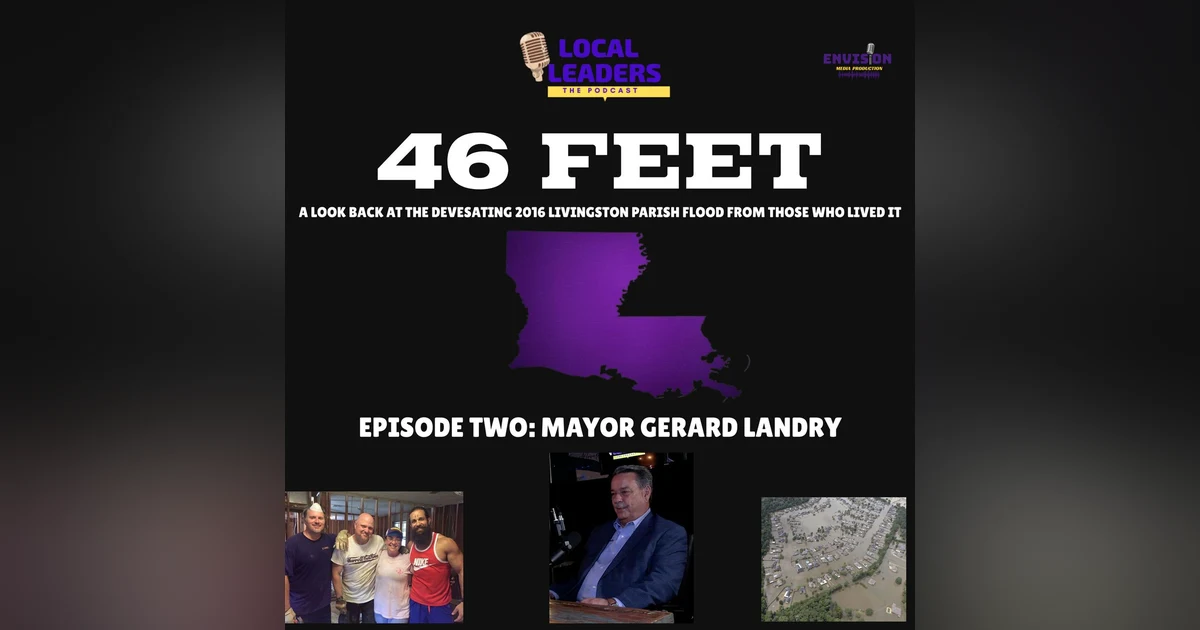
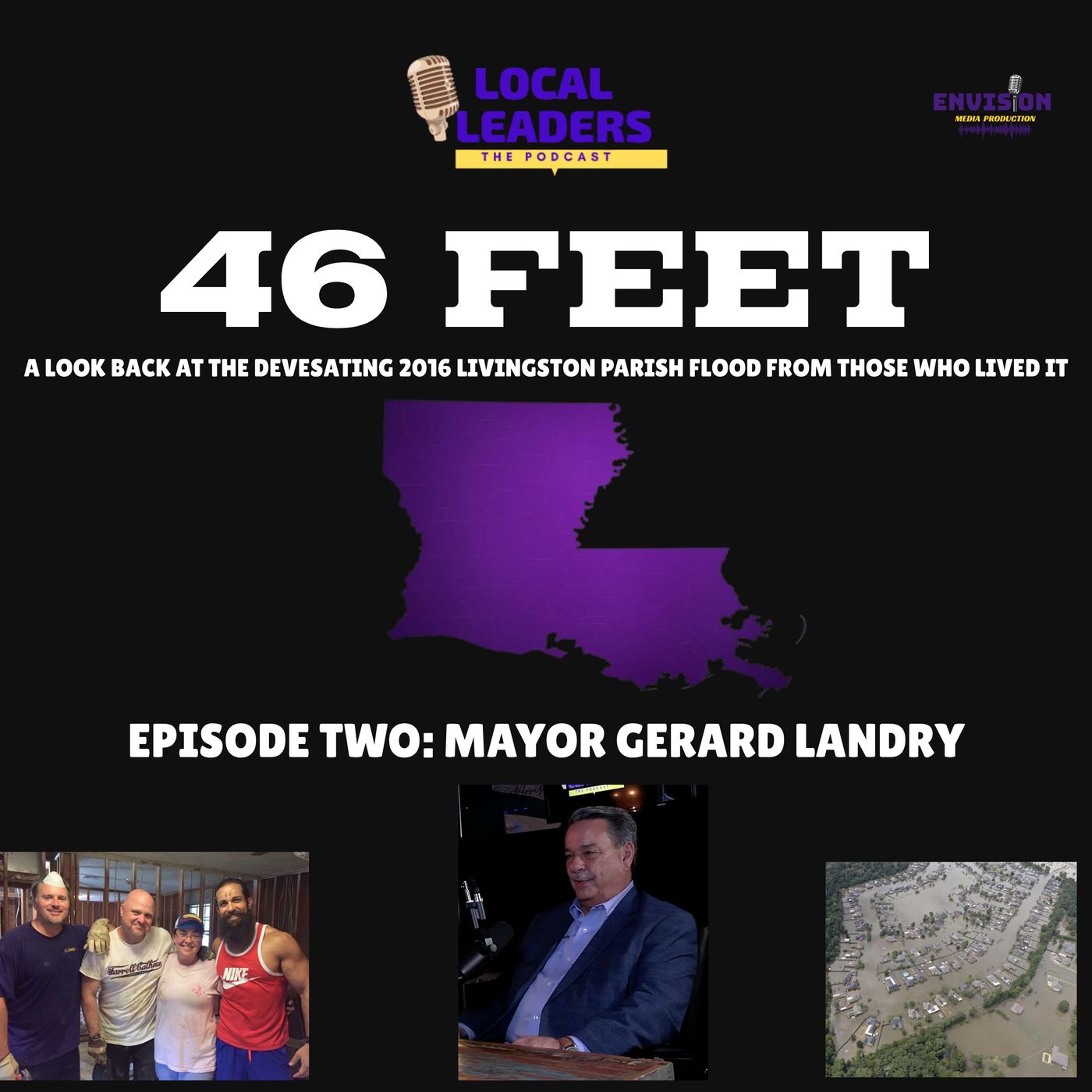
Episode Two | 46 Feet: The Historic 2016 Livingston Parish Flood 10 Years Later

 Apple Podcasts

 Castro

 RSS Feed
In this episode, “Local Leaders” Host Jim Chapman sits down with City of Denham Springs Mayor Gerard Landry as he reflects on the 2016 flood in Denham Springs, describing the scale of the rainfall, the widespread damage, and the difficulty of recovery in the weeks that followed.
The city had prepared for severe weather and had financial reserves in place, but the disaster still exceeded expectations and left many residents confused about rebuilding and insurance. Mayor Landry shares stories about the human toll, rescue efforts, cleanup, and residents trying to return home, and he describes how the city used a community planning process to guide rebuilding and preserve historic places while becoming better prepared for future emergencies.
In 2016 an unpredictable storm caused unprecedented flooding in Livingston Parish Louisiana and surrounding areas like Baton Rouge. A decade later, Livingston Parish has come back stronger than ever. In this special presentation by Local Leaders the Podcast, you will hear not only hear the personal stories during that flood, but the comebacks that followed.
Timestamps:
04:47 The Day Before The Rain Came
06:58 FEMA Frustrations
09:56 Graves Steps In
13:28 Rescue on the Water
16:04 Donald Trump Visits Denham Springs
19:24 Cleanup and Rebuilding
22:09 Denham Strong Begins
23:48 Business Bounces Back
31:51 Preserving Local History
35:42 No Regrets
39:09 Aging Out Gracefully
0:30 In August of twenty sixteen, prolonged rainfall from an unpredictable storm resulted in catastrophic flooding in the state of Louisiana. In my city of Didam Springs, ninety percent of the homes received water, some forty two hundred homes. Of those, three thousand of these homes received eighteen inches or more of water twenty five to thirty inches of rain in less than seventy two hours. The Amete River, which cuts through the heart of Livingston Parish, crusted at forty six point two feet, some five feet above its previously recorded record and some seventeen point two feet above its flood stage at Denham Springs. Hey everyone, and welcome back to local leaders of the podcast. Of course, we are continuing our series on the twenty sixteen flood. It has been a decade since that flood, and today joining me is someone who he'll be the last person to tell you how integral he was in this flood, but in the Denham Springs area, I don't think we could have done it without him, and he will come bath at y'all.
2:00 He's very humble, but I am proud and happy to have my friend Mayors Gerard Landry on the show. And here's an interesting stat for you, Mayor, you are now my highest returning guest. This is your fourth appearance on Local Leaders. So going to negotiate a contract. Yeah, that's right. And so you've announced that this will be your last term as mayor. So I'm like, wow, he can come in and be a co host anytime right here at Local Leaders and we can sure have a lot of fun. But glad to have you on the show. Thank you for green to come on, of course, And of course does it seem like ten years?
2:44 No? Where did the time go? I know, of course, you know we're talked about ten years or twelve years in office. Gosh, I'm going to be seventy four years old in December. Where did all those years go? Yeah? It's just amazing, it really is. And you know, if you would have told me looking down the road at the water that day ten years ago, I would have told you it's going to be a tough task to get back from this. As a matter of fact, I remember vividly thinking that, sure, what about you? Yeah, I feel the same way. You know. Wbor Z did a interview about a week or so ago and the state climatologist revamped his estimate of what the rain event was. We talked about one in a thousand years. Now they say it's one in a ten thousand year event. That's hard to comprehend. That was a lot of water in just twenty four hours, and that's it's hard to beat. Now, you just how do you handle it the best way you can?
3:42 Right, that's right, that's right. And you know it's interesting. We knew some water was coming, but as a matter of fact, y'all were preparing for it, right. Yeah, typical rain event that happens our hurricanes. We all get together, all the department heads, and we progressed so far past this what I'm getting reay to tell you. We'd all get together the PD and we'd all have this discussion. Make sure you have sandbags, make sure you got sand make sure you got fuel, batteries, all that kind of stuff. In retrospect, none of that stuff mattered, right, But now that we've put into work that we don't hopefully the next event, because there will be another one, what's it going to be, We don't know. As a city, we're better prepared than we were at that time.
4:23 Yeah, We're proud of the work that we have done in all areas of managing the city. Absolutely, and something I've always wanted to ask you now, you know, I know, it's hard to think back to just prior to that flood happening because of the obviously the devastation and in the total shift in your plans of what you were going to do for the city. You were in office for about a year and a half, and I'm sure maybe that you know, two three days prior to that, you had a lot of plans that didn't relate to dealing with a twenty sixteen flood. Do you remember maybe something that you were Okay, I'm gonna start, you know, this project. I'm gonna start working on this project and boy to get put on the back burner.
5:12 I can't tell you a specific project, but what I can tell you it's just a year and a half into the job, right, Yeah, And coming out of the retail arena, there was a different mindset that I brought to the city operations. And not that Jimmy Durbin, which I love dearly, not that he was inefficient or whatever, but we just had a different focus. Sure in mind was more on people and cost controls and that sort of thing. So we were year and a half into GPS on all the vehicles that we had limitations on take on vehicles and all the kinds of things they go into the operation of the city, and trying to try to save money where we could, because maryor Dearbin told me, he said, you need to have about two and a half million bucks and this I hate to use a slush front or rainy day account, but you got to have some backup fors. And after my first year when we went into the flood, we had about five million dollars, and thank god we did, because that's the only way you can recover because FAMA is strictly a reimbursement process, so you write a check for a million bucks to get something done to give you back ninety percent, and so thank goodness we had the funds to work with. So that was my biggest focus at that time, was just trying to be as efficient as we could and become the shining star that we're financially sound.
6:29 Yeah, and I think, you know, thankfully obviously for that, because you bring up a good point that they don't just send you money, they reimburse you for the money you've spent ninety percent or so. You did an interesting interview with Kieran Challa that has aired prior to this airing. So I don't want to necessarily rehash what you talked about on that show, but I want to talk a little more about the recovery of the city. And one of the things you did was you went to Congress just shortly after this flood, and want to I want to talk about that for a minute. So when you were in Congress, you spoke to them primarily to voice your concerns in the way FEMA had responded initially to that flood, the way they were inconsistent was your terminology with the citizens at that time. They would tell them one thing, then they would say, oh no, we've you know, changed our mind, or you can't do that. And these citizens were coming to you. You were the mayor. You were the guy in their mind that could help them, and you were also the head guy in charge at that time, and you were getting strung along a little bit and weren't getting the proper answers. Maybe a better way of saying it. As a matter of fact, I'm going to quote you in that you said to say I am frustrated, disappointed, and angry is an understatement. Take me back to your feelings during.
7:59 That when everybody's hurting and you know you've gotten past the point of rescue. Now we're several months into the recovery process and you see people that are continuing to hurt and the ridiculous guidelines that we had to go and follow. I understand now after ten years, a little bit more about why the guidelines are there. Sure, that's a topic for another story, But FEMA does not have a good track record of how they present themselves and how they offer help. I can remember a ninety year old gentleman and his wife, and they were the recipients of the first FEMA trailer. All he wanted to do was the server's wife coffee one more morning, because they couldn't.
8:40 I was able to get them their home. My uncle, Hewitt Underwood, all he wanted to do was to be able to get back home and see his grandkids and great grandkids. And he was a decorated veteran and he had addresser drawer that was in stories because he had time to exact wait, and he just wanted to get back to the first thing you looked at was all of his medals that were in the top drawer, and that meant so much to him. It's the little things in life that really count amen to that. It's the good things. They're going to fall into their place. But when FEMA comes in and there's a mixed bag of messages, everybody's going to have to elevate their homes.
9:20 Oh no, and everybody's not going to have to tell of it. That's not the way to fix the problem. The way to fix the problem is to work on drainage. Yeah, okay, And that was the mitigation piece of that where if you I think it was eighteen inches, if you got eighteen inches or more of water, they were wanting to force you to either elevate or you wouldn't qualify for flood insurance if you rebuilt. There was all kind of stuff that was out there. It was so difficult to navigate. And thank God for Garret Grayce and his his work on the hill to make sure that we had the voice that we needed up there. And you just transitioned into my next conversation, which Garrett Graves I distinctly remember two people fighting so hard, not only in Congress with Garrett Grays, but here locally with you, and you know, you kind of teamed up a little bit, and he seemed to be someone that was very integral to being your voice in Washington.
10:17 Yes, he was. He cared what we said, he cared what we thought. He cared about. What our citizens were saying because they were his as well. When you come right down to it, just at a different level. Right if I take the marriage where the road meets the road, and then everybody else is above that. And so he was very cognizant of what we had to do. There was a day or two or three after the floods or after the waters had receded, and we had already started to gut our home with church members and family members, kids and everybody coming to help, and out of blue, he calls me up. He said, how you doing. So I'm doing okay. He said, I'm around the corner. Can I come by? And I said, why should come by the house? And so he came to my house and uh, and the cabinets were going on, I mean, the house was just pretty much destroyed, and we had some chairs on the back porch and we sat down there on the back porch and Mary said, Garrett, would.
11:08 You like some coffee? He said, I'd love some coffee. So she goes inside and everything above the counters was okay. So she got to coffee boy, she'd made coffee, and she brings us out on some fine chiner and he says, nowhere else but in South Louisiana in the middle of a flood. Would you get served coffee in fine china? Amen? But that's the only thing we had. Yeah, But you know, but the fact that it came to my house just to talk and just to kind of make sure that I was okay. Yeah, because every level has to be okay in order to walk through this whole process. It's an enormous amount of pressure. And yeah, and I can imagine the I can only imagine the weight that comes with that. Because you just brought up another good point that well we'll touch on briefly, and that is you had ten thousand citizens, okay, that three thousand something of rooftops that have flooded. All of these people were looking at their leader, Mayor Gerid Landry for answers and at the same time your own house flooded. Sure, and for two days you were not with your family.
12:13 Is in the water with boots. I didn't realize what happens to your toes after two days in rubber boots full of water. It's painful. Yeah, okay, I agree, you know right, And you know if you got any arrest at all, it was in the parking lot of Walgreens in your car. If I get cat naps and what have you. But you know, my my biggest person that I want to thank is my wife because she called me and she said, baby, I got this at home. Church friends are her families here, they're helping me get to the house. You got ten thousand people looking to you. So I can't thank her enough for what she did to make sure that I was okay so I could serve the citizens. Yeah, we can't think her enough. Well, she's a special one. She is, indeed. And I want to say one more thing about that congressional hearing, if you will, or committee meeting.
12:58 And that was another quote that you said. Uh, you said, our citizens love our city, and I love my citizens and I try to be their voice. Now, mayor, if you can put that into words, what did the citizens of Denim Springs mean to you during that time? These people were hurting, and I was just I'd like to fix things. I like to take care of people, and uh, and it's it's it's hard to see them suffer. Uh. When for two or three days we were just pulling people out of the water. They would come up on boats and Cajun Navy or probably that's probably the beginning of the expansion of Cajun Navy, and they were bringing people up to the water's edge. Now the water's edge happened to be a flaudable afore right in front of you. Hey, I thank you, but uh yeah, and so you know, you take those people out and they were so grateful, and uh. I was getting calls from some some people that we know, have you seen.
13:52 Mom and Daddy? No, it hadn't, but I'll keep an eye out. And I can remember one of one of our cousins college. She said, have you seen mom and Daddy? And I said no, but I'll keep an eye And don't you know, they show up in air Voat about thirty minutes later, and I called her back. I said, I got you mym and daddy that ran my car in the Officers parking lot. And she said, I'm sending to my husband. Wow, I never saw him again. Oh, I saw him again much much later. But those are the little things that really count. And so many people afterwards. Man, I know you don't remember me, but. You pulled me out of the boat. I was on Florida Street, or I was on Range Avenue, and you know that's that's stuff that I I'll never forget. Yeah, you know, someone said to me during this flood, there was a point where I was looking down my street and I lived on one street subdivision called a sack in the back, and you know, fifty inches of water in there, most of the houses, all the houses.
14:49 And my neighbor walked up to me, one of my neighbors, and he says, you're right, because I was just staring and I said, uh, I don't ever want to forget that us because initially my first thought was this town is decimated. We're finished. And then something kicked in where I where I said, uh, if I have anything to say about it, we're not gonna be finished. I'm gonna do everything I can to help people. And I was in the paint business at that time, and I knew, uh, hey, they're gonna have paint for them. Walls because I'm gonna call the owner my company and say, we're gonna sell it to them at cost. Anybody in Denim Springs, Livingston, Paris, We're gonna sell it to them at costs. And you know, my company, which is as fertile as they come, they know how to make profit. Let's just say that. But my company said, uh, we'll do whatever we need to do to help and and uh maybe proud to work for them. And we did. We helped a lot of people at least not have to worry about how much paint was gonna cost them. Sure, and and uh and I was forever grateful for that. But there were so many people with that story. Now, you know, you come back and one thing I want to mention President Trump, who was not President Trump then he was Candidate Trump at the Denim Spurrings High School and through the Antique district.
16:19 Tell me about what that experience was wanted. I was at the trailer that we've at this time, we had a trailer at the Walgreene parking lot that we were working out of. It was like a command center, if you will, because it had our radios and phones and everything that we needed to be able to operate. And I get a phone call and I don't even remember who it was, but it was a male voice, and he said, President Trump is coming to Dinham. He wants to see you at the high school. He said, see you. But it didn't dawn on me. He wanted to see me, right, and so you know what I mean? I call Mary and the kids were at the house, and Robert Pool, my council member, who was invaluable through this whole process, was with me. I said, Robert, let's go see Donald Trump. Okay, let's go. So we get my car and we go by the house and pick up Mary and the kids and we tug off to the school. There's nobody at the school except the principal.
17:08 I said, okay, so I see him over there. So I'll pull it right up to the door. And hey, Mayn, how are you doing? I said, fine, what are we doing? He said, Trump's coming to see me and you how about that? How about that? Right? And I said, here comes this gentleman, cheap blue suit. Guess what he's secret service and he's got a little earpiece on what's a little called out think that is dock? You know? He said, who are you? And I said, I'm Gerard Landry on the mayor. Okay, you stand over here by the by the principal. Who are all these people? This is my wife and my kids and counselor in the pool and rank some of my grandkids. Okay, behind the rope. So I said, all right, Mary, would you move the truck over for me? I said, He'll wait right, So. I called Uh. I called Uh, Jeff, I'm Jason ord and lost and.
17:54 The parish president late. I'm sorry late. So I called both of him. I said Trump's on his way. He said, yeah, we heard, and I said okay. So they eventually show up and they come up there with the principal and I and the same secret service guy. He said, who are you? He said, I'm the sheriff. He said, get behind the rope and who are you? He I'm the presh president he said. He said, what in the world's going on? Right? I figured that's who he really wanted to see. But he came and has small authorage and I think two vehicles, and he just wanted to say, I feel your pain. You're going to be okay, Yeah, you got it. You're gonna make this. You're gonna make the recovery and it was just encouraging words and it was good to seem And then there was a photo ops that that they went along and I think he would help pass water out some other places.
18:39 But it was honored to. See to meet him, and he's just as genuine, mild mannered him and Mike Pence both and so it was it was a good feeling. Right at the picture. I think you've seen that picture in my office. I have, and well, we all look kind of rough. But well it was a rough time, it was, but in the uh, in the amazing unique experience in such a tragic time. Uh. And one of the things that when I think at Donald Trump, I think of he came down here and he didn't have to and uh and he wasn't even president then, and all those things impressed me about him and kind of spoke to me about who he was maybe sure, And so I think, I just think that's an awesome experience. But eventually you get through that aspect and it's time for recovery. And I will imagine from a mayor perspective, you know, one of the things that you had to deal with was sadly everybody's belongings or out out on the sidewalks right and in their grass and in their yards. And I mean, I'm talking everything from pictures that you can't replace to computers that you can and somebody's got to pick all that up. And how is navigating just the cleanup.
19:55 So FEMA comes in and they've got their SMEs subject matter experts. I would challenge the word expert on some of these folks that I had to deal with. But they had the resources, they had the information that you had to deal with. And boy, the monumental task of picking all this stuff up. Oh my gosh, you've seen the pictures. Yeah, And they could roll down the street and they had these great, big, huge trailers. They would make it halfway down the street and before and have to go to the dump and. Dispose of it and come back. And this FEMAE has so many regulations about what you can and can't do, and and we can't pick up this, and we can't pick up that. It's just it was a mess. But there was a few female employees in there that understand and understood what happened, what has happened, and how there's always a way to get around something.
20:43 Okay. And the thing that you talk about, the inconsistency if you ever bring up the thing, well, you know what y'all did is in New Jersey. How come you're not going to do it here? Oh okay, all right, we'll do it then. Yeah, And so I'll pull that card quite a few times. But because of the experts that we had working with us, were with the FETA that information, and I was just a mouthpiece. Yeah, and it worked. Out well yeah, uh you know. And I can remember mayor uh when people the water were seated. Everybody's going back in their homes and gutting, and you really didn't know at that time. You know, I was hearing everything from don't touch nothing, FEMA has to look at it first, to you need to gut your home, and and but only cut at four feet and all, you know, just all this conglomerate of information. We've all become experts. Now, right, this's ever happened again to any of us that are already here, knock on what it never does. But we're gonna know what to do to start. And most people don't even have carpet anymore because we carried out so much of it during the flood right again, No, I.
21:50 Don't have a stitch of carpet in my aus. It's all woodlake cera mcdal, which is water bruders have to worry about it. But you know, aside from all that, it was a learning process for many and you were at the helm of it. Denim Strong comes around. So Denim Strong is fashioned after the a female program. It's called the National National Disaster Recovery Framework, and so it's a program that's laid out there for you if you choose to follow it. Miss Sandra Gunner, who was with the Office of Community Development with the state, came out to visit. She was such a sweetheart, and she says, you need to do this. You need to do this program and you will reap the rewards.
22:37 In the end. Okay, fine, so let's do it. Gosh darted that she was right because we had this series of meetings. We had three different meetings, and it was a way for the input from the citizens guided us on what we needed to do. I use the story all the time. Look, you hired me to drive the bus, but the citizens are the gps. You tell me where you want to go, you tell me what you want to see you tell me what you want me to do. And so I was told by some of my friends in boundaries, Man, if twenty or thirty people show up, you'll be fortunate. We had eight hundred people show up. That's amazing. And that's because the level of devastation and our people's commitment to our city. They wanted to stay here, they wanted to see where we are today. Yeah, and I think we've made some significant process of progress over this ten years, absolutely.
23:26 One hundred percent. And as a mayor, you know, you're in charge of so much. And one of those things is is attracting business because business generates tax dollars. Tax dollars are required to run your city, and sales tax dollars are the best. Dollars, right, And I call other people's money, yeah, other people's. Money, that's right. And so after something like this, what did you think about the business aspect of things? You know, you would think a business may be scared off from building in the Dinom Springs or rebuilding their store that didn't Springs area again, because this happened. People people had brought that question up to me several times, and right off the top of my head, I can only think of one business that didn't come back. Yeah pipeyes, yeah, I still don't have and I get frustrated because I have to go or go to see I mean O'Neill Lane to get my fried chicken on Sunday after church.
24:25 Okay, yeah, Popeyes come back. Yeah, but you know, the owner had like one hundred stores, and this is just one he chose not to rebuild. And of course he Ces Coffee came in and took over. So it's a it's a win. That was okay, right. Our sales tax collections spiked right after the flood, as they should have because everybody had to buy cars, furnishings and all that sort of thing. Right. It didn't matter where you bought your car, because you paid the sales tax for your address, right, And so there was a lot of cars bought home depot. I mean, my goodness, their sales skyrocket after building maturers had to be furniture, all those sorts of things were phenomenal. Commid of fires. Oh yes, all that stuff we needed. But here's the interesting thing. Everybody's rebuilt and the cars have been bought.
25:06 Our sales tacks are continuing to climb. Yeah, and we are. We're at record highs. So that means something about the city and Dinner Springs and about our people and about people that are attracted the Dinner Springs. Juben is booming. You get juven mile one, two and three now phases right, We're doing this other thing with the convention or conference center and the hotel and that's going to have sixty acres of more retail that we're planning on. So those are the kinds of things to help bring your city back, and I'm committed to that. I think I shared with you that one of the things I will continue to do after I leave office. In New Year's Eve was, by the ways, my last day. So New Year's Eve has a new meeting for me this year. But I'm going to stay on the DEMCO Business Development Center Board of Directors and try to maintain that flow of new people come in here and what is it what does it mean to do business and dinner because we are definitely business friendly.
26:04 One hundred percent. And you know you got also the right around where this uh this new development is going to be built. Uh the Cook Road extension is upened up. Wow, it's at a time. So did that took it took what eleven twelve years? Uh, yeah, conceived in two thousand, it was first talked about in two thousand and six. That's the Richard Richard Baker, where's the congressman at the time, that actually got the funds and it was supposed to be for the Peace Highway interchange. Yeah, and then it was moved over to the Cook Road. Yeah, that's fine. It's a lot of them are needed. All of them are needed, and. We'll continue to work towards get the interchange. Well somebody else will, but yeah, the hizz Peece Highway still needs an interchange there. I don't think we'll ever have winter for each Club Road. It's too close to the to the river and to the bridges over there. But there's are other things. There's are other traffic circles that we're trying to work on, and there's a lot of things that we have in the in the pipeline, mainly at the interstate here and dinner.
27:01 Yeah, and so all that's going to help business as well. Yeah. And and ten years post destruction, beyond belief, I had a uh it's actually my wife's cousin, thank god, her and several of her you know, her husband and and they brought their kids and hey, we're going to help you gut and all these sort of things. Thank God for that. But I'll never forget when she drove down my street, and it's an interesting perspective because they're from Lafayette. She drove down my street, got to my house, and I mean, and soon as she steps out, she has tears in her eyes. And she said, I saw it on TV. But seeing it in person, you know, uh, total different. You said that in Congress, you said you got to come down here and you got to see it for yourself. If you weren't here, you will never fully grasp it. Like Caseo. That's how described as like a war zone. It was driving down and seeing people's lives in their front.
28:07 Yard, lost everything that you owned, everything, kids, grand kids, come back, Grammy, Papa, where's all my toys? Yeah, where's the stuff that was in this closet? It's gone. I remember Marian had a good friend that I was one of the first ones that we knew that got her house redone. As she moved back in and Mary called her, so, I know, you're so excited. She said, yes, and no, I'm glad it's done. I'm glad I moved back in, but I feel like I'm living in a holiday in. Yeah, because all my stuff's gone, everything's new, everything's fresh, everything's painted. I just don't feel like i'm home yet. Yeah, And I guess at some point in time you just have to accept it and maybe the mine works and lets you forget it used to be, right, Yeah, so that you can go forward.
28:49 That's right. Yeah, that's right. And uh, you know there was a time you get perfect transition there you you got beyond it and at least a little bit. Do you remember how long it took from the flood to the time that you maybe sat down and said, I think we're going to be okay. I think this is kind of behind us. I think probably yesterday or the day before. Right. I don't know that I will ever say we're done, because there's too many things to do. Yeah, and maybe it's not necessarily a flood root leader, but if you have your mindset on trying to make dinner springs even better, there's things you can do every single day. The new administration that comes in is going to have some different ideas, and I welcome that. It's the variety of ideas that all of us have as long as we're concerned about the citizens and about the growth of the city and not to lose what our history is all about.
29:48 I love the history part of what we do, same like we're doing. We're working on Spring Park right now to bring back that whole thing, which is something that's been sorely needed. Do you worry about dollars and cents and how do you get it funded? And you know what, we have a grant writer and we get small grants here there, and we just chip away at it. And finally, you know what, we've already spent probably this year we'll probably approached it in a half a million dollars. Just on Spring Park. We were able to get the Louise and Er Watershed Initiative to demo the first Baptist church site and get them a few dollars in their pockets. And now that that site is going to be well, the bell tower is still there, and I make sure that that state and a local family donated a plaque that went on that brick wall.
30:31 And then we've rehab the first Baptist church cemetery that was ever since the late eighteen hundreds, all these things are historical in nature. But if you don't know where you came from, you don't know where you're going. That's right, and you've got to appreciate that stuff. And you know one thing I can tell all the listeners out there and viewers right now, I've done several of the mayor's tours personally in his car, and you've brought me around to these the these gems of the city that sometimes people don't take the time to, you know, they just don't have the time to sit down and appreciate this, the historical aspect of the city of Denham Springs.
31:14 And I've never seen someone prouder than you of your city and its history. And uh, you know, there's a new mayor race coming up. I don't know who's gonna win, who's gonna lose, but I'll tell you this, I hope they have a heart for the city and this in the the history of this city, and they understand how resilient these people are. I don't think, uh they're you know, I'm biased, but I don't think there's many people more resilient than right here at home. Right. I think you're exactly right. So we have so much to be grateful for in our city. Uh. You know, we talked about all the historical places like like the Springs and the first Baptist racial location, the first Baptist church cemetery. You know, we did a story which I pastor and looked at the first Baptist Church, the new campus and so that you got the old and the new, you know, from before the flood and after the flood. So it's so dynamic. The Dinim Springs Housing Authority, the Hut project here in town has been totally destroyed. Now now it's the Dinm Springs Housing Authority.
32:17 We're going to do a ribony cutting on that probably in a very few weeks. Spring Park, right, Spring. Park, This is another that's another big issue. People don't realize this either our downtown district, the antique district. Do you realize that we have We have awards, it's frobably four or five different awards for the quality of the retailers that we have down there and our downtown facilities. Uh. There was a tour bus that came through about two months ago, three months ago, and it was a. Group of main street folks that came to have a convention in poor Dolland and they came to Dinner Springs and had lunch at Lishen. They could have gone anywhere else that they wanted to go, but they wanted to come see. Next month we have another tour and it's four different states are coming to Baton Rouge and it's about antique districts, it's about center city.
33:06 Where are they coming? They're coming back to. Dinner Springs for four different states. Now they're coming to Dinner Springs to look at our downtown district. We have so much to be proud of of what I have accomplished there. Yeah, and historical, historical, historical, and you know, shout out to Donald Jennings. Yeah, does the region mentioned Main Street, the Antique Merchants Association. That's a valuable piece of our history and we can't let that go. You know, we can do whatever you want to do something different, But you know what, those shop owners are proud of what they have. Yeah, Okay, some of them are so small they just support their hobby. But that's okay. You know, I love it, I do. I do. I love it too. Yeah. It's a key part is the integral part of our city.
33:48 The historical aspect of what we have done since that time, because some of those buildings have dates on the front of them, these roze plaques that we put on there a couple of years ago to identify them as historical places. Yeah, can't. You can't just buy that. You can't recreate that now, you can't decades decades and not centuries in the making. Yeah, And that's what we have here. And a beautiful city hall. And if you if you live here and you've not toured our I don't know if you call it historic city hall. Yes, yeah, if you haven't toured, that said, don't go to the real city hall. Tour let me let me clarify they're different. We have the old city Hall, which is the one on Matti Street that we have we used to call wet City Hall, which is the one on uh on By River Road Government Street Drive and that we lost during the flood. Yeah, and it has a nice pavilion there now that's available for the public to use. The Municipal Oaks Pavilion is what it's called. Yeah, there's one similar to it at at Spring Park. And now we have the new improved city Hall. Yes, but it's also located on one of the highest pieces of property in the city because it didn't flood. It's historical nature because it's been there for probably sixty or seventy years. It used to be a livings to State Bank and then to make transition to trapping a wound to one and that's who we ended up leasing it from for recovery and ended up buying it because I got it for for ourself. We negotiated a really really good deal. Especially guess what it's paid for. It's surely serviceable. It's in the heart of town and you've been through it. Oh yeah, it's it's it's perfectly fine. It's not the taj Mahall.
35:19 It's City Hall. It's City Hall. And but I'll tell you I've been in your office many times and and you have one of the best views of the city because you open up that that window in the rear of that office and there is. A beautiful and distric Yeah, exactly right. You can't beat that. No, it's a reminder of what we're here for. Amen to that. Okay, let me ask you h to wrap this up. It's been ten years. A lot has changed. There's been so much positive change. You've I'm sure learned many things along the way. What would you say, or would you say if you could go back and do it over, you would have done it. Is there anything you would have done differently during the flood relative to the reaction to it.
36:17 No, we just did what we thought was the right thing to do. Nobody has ever called me and said, well, I wish you could have done that. So I wish you could have done that. Uh. You know, people are when you're genuine with people, they truth really treat you with respect. And I appreciate that. But I'm just playing with trot. You know. I fust at you all the time for yeah, yeah, mister all right, mister Chapman. But it's uh, you know, it's it's it's the way that it's the way that we present ourselves. It's the way that we work with each other, the way that we love each other. You know, I think a lot of times after you and I get through a conversation, I say love you, brother. And you know, there's some local pastors I want to brother Johnson, who started the Pentecostal church. He always wore a three piece suit. He was always so dressed up, and he was always so polite, and every time we talk, you say, mister Mayorthith and mister Meryorth And I said, why don't.
37:14 You call me Girard. He said no, my daddy would kill me if he heard you call you Gerard. And I said, okay, but it was a very very good man. But one of the things that he said that he's just profound to me, he's really civil. Just be kind, Yeah, just be kind, and that's all we really need. Just be kind. Amen to that. One more thing. I would love to have you on and we'll extend your record of appearances one more time, and we'll wait till it's about thirty days out from you leaving office. And I would love to just do a podcast where we took the listeners and the viewers on a journey of your historic time as Denim Springs Mayor. I think you know obviously I paid attention, and I know that you would never admit to it. But I always say this on every episode we've ever done. I don't believe I believe it. God puts people in specific places at specific times for specific things, and sometimes we don't understand that. I don't know that there's many people out there that could have been in your position and perform the way you did. I hope you know how much of a difference you made to the citizens that you serve. You were the calming hand.
38:43 You were someone that you could look at and at least felt like, Gerard knows what he's doing, you know, even if you've maybe learning some things on the fly. But that's what we needed during that time. My shift in my mindset during this flood came when you spoke in front of Congress and you were so passionate about that, and you know, when you're running for office and you win office and you do a great job. I think of two people personally that I respect. One, obviously is Mayor Gerard Landry. Another is Florida Governor Ron DeSantis, who did a phenomenal job in Florida. And I bring that up because he's turning out he can't run anymore. And I have went through my life back and forth on term limits, and I'm like, uh, I like him because you know, it keeps someone from having power forever. And then I had a stage where I said, well, you know, it's a voter's choice, and if they want to run forever and people want them in office forever, they can vote for that, and back and forth. Rhanda Scientists is a good example of someone that if you had it your way and you lived in Florida, you would probably never ever want to lose him. He's done a phenomenal job there, It really has I would I would say the other option to that is you you age out.
40:06 You just get to a point where you want to do some other things in life and you want to spend time with your family and your wife, and that's where you're at. But I wish we could have kept you forever. And you know, I have a wonderful wife, and I have seven children that are fantastic. I have thirteen grand babies that are fabulous, and now we have eleven great grand babies that beat every other grand in the world. Yeah, so yes, we are aging out is a great way to put it. Yeah, And I don't mean that in a consulting way by any means. I don't take it that way. Yeah, But at some point in time, you just have to realize, I've always tried to put family first, and that's good God. Family and then work. That's it's got to be your priorities. And you know, I'm guilty of being an orcaholic. Work too hard, but you know it's good.
40:58 Life is wonderful and and I want to be able to take some time to enjoy them. Yeah, and some of them need to know who great grap A is. Amen. And I can't tell you how much we appreciate it. No one deserves it more than you. I love you, guys, love you. And so that's going to wrap us up. I want to thank everyone for listening, supporting, share the show wherever you get it. We got some more episodes focused around the decade since the Great Flood of twenty sixteen. Until next time, I'm Jim Chapman reminding you love your community, support local business, and keep leading. Thank you very much,