
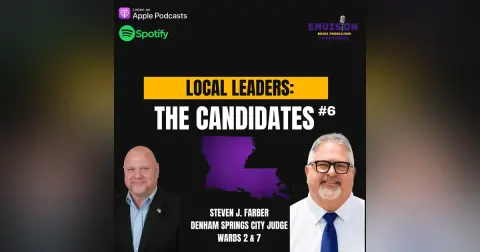
Local Leaders: The Candidates #6 | Steven J. Farber - Denham Springs City Judge Ward 2 & 7

 Apple Podcasts
 Castro
 RSS Feed
 In this episode Jim Chapman sits down with Steven J. Farber, a candidate for Denham Springs City Judge Ward 2 & 7 about his background, legal career, family and plans should he be elected as Denham Springs City Judge. Steven discusses his education, his work in law enforcement and juvenile justice, and the path that led him to study law and practice in public service roles.
He also talks about why he decided to run, the qualities he believes a judge should have, and the kinds of cases the city court handles. He says his priorities would be improving efficiency, reducing backlogs, and protecting due process.
You can learn more about Steven J Farber by visiting:
https://www.facebook.com/profile.php?id=61592733763697
Timestamps:
06:15 Southern University and the Bar
07:33 State Work and Legal Experience
09:54 Family and Public Schools
11:34 Why Run for Judge
14:50 What a Judge Should Be
16:50 City Court Explained
20:44 Sentencing and Self-Representation
24:51 Clearing Backlogs and Efficiency
28:07 Contempt and Court Discipline
Tags: Stephen Farber, Denham Springs City Judge, Wards 2 and 7, legal career, law enforcement, juvenile justice, public service, judge qualities, court efficiency, due process
0:00 Hey everyone, welcome back to Local Leaders of the Podcast, and we are continuing our series on the candidates this week. Today I have sitting across from me Stephen Farber, who is running for Denham Springs City Judge in Wards 2 and 7. So first of all, Stephen, welcome to the podcast. Thank you so much. I appreciate you having me on the show for a second. out and people will know me a little bit better. Yeah, that's right. And that's exactly what we do here. We're going to bring them on a little journey through your life and how you ended up in the law. And that always starts where you were born and raised. So let's start there. Where were you born? Sure. So I was actually born in New Orleans East. Okay.
0:42 Off of Morrison Boulevard. Yeah. And my dad and his father and his brothers all We're working at a beauty supply place down on magazine street. Oh yeah. Yeah. And that was the original Sally beauty company. Really? Oh, that's interesting. They ended up selling that to Alberta Culver who went nationwide with it. So they had one sister, her name was Sally. That's who they named it. And with that, you know, they got some stocks and whatever. And then my dad was going through pharmacy school and he started his pharmacy with that money. But we moved over to the West bank. Yep. So, Tarrytown. Yep. The best thing. That's right. The best thing. From five years until probably about 18, 19 years old, right there in Tarrytown. And I grew up there and went to public schools there.
1:27 Very good. Yep. And then came up here to Down Springs where I met my wife. Yeah. Somehow you ended up in Livingston, Perry. Yeah. My wife's a lifelong resident here in Down Springs. Okay. And the best florist. Oh, yes, absolutely. In history, in my opinion. You know, best of 225, best of Baton Rouge for two years straight. Yeah. Out of all of the area. Great work. So we're local business owners as well. So we have a lot of investment here in the town. Livingston Parish ladies don't leave home, do they? That's right. You want to marry her, you got to come over here. I still remember coming up here when I was young and didn't have a Bass Pro. You know, they had a corner grocery store. That's right. It was very rural back then. People would still leave their keys in their car and not even lock their car.
2:09 And I'd come up from New Orleans like, what are y'all doing? You know, come from New Orleans, I lock my car everywhere I go. Yeah, that's right. That's right. Different world back then. Yeah, absolutely. So you end up going to college. Let's talk about that first. Where did you go to college? So I started out at the University of New Orleans. Okay. When I was, I started out. Four years out of us. So I went to military school for high school. Okay. Yeah. And then. What school was that? Missouri Military Academy. Okay. Mexico, Missouri. Okay. 56 of my graduating class. Yeah. And we were an exceptional private school awarded by Ronald Reagan at the time. Oh, wow. High education school. Yeah. And we had like five people that went to West Point and stuff out of there. Yeah.
2:53 I decided not to go to college right away. Okay. I went and worked for the sheriff's office in Orleans Parish. I worked as a prison guard for about two years, working 12-hour shifts. It was hard. Especially that in New Orleans. I was a bigger guy, so I had to work the disciplinary tier. It wasn't nice. And then I got an opportunity. Sal Liberto, who was the constable of Jefferson Parish, hired me on to be a deputy constable, and I went and did physical evictions there. Okay. So I did the actual fix still on the court side. Oh, that was fun. You issued the eviction. Well, the constables or here, probably the marshal does the evictions here. Yeah. I did those.
3:34 So you go knock on the door and say, oh, it's time to leave. You're not paying the rent. I had to rest because they refused to leave. Yeah. I got post-certified and all that good stuff. Very interesting. And at some point you do go to college. You went to UNO for a little while. I started out in pre-pharmacy. I thought I wanted to be like my dad. Yeah. But me and organic chemistry just didn't match. I know the feeling. So, you know, I transferred and I went to sociology with a concentration in criminology and a minor in psychology. Wow. And that's when I transferred to LSU. And LSU's sociology department is like top ten. Yes. And it's all essay tests. Yeah. So it really prepared me for where I was going. Right. Because, you know, if you were taking psychology, it's going to be multiple choice. But I had to write out my thoughts in those tests. And my wife's the one that actually convinced me to go to law school. She said, why don't you take the LSU?
4:24 So you were married prior to going to law school. So in 92, me and my wife got married. And that's when I moved up here to Baton Rouge to go to LSU. That was part of me transferring to LSU. Because we moved up here. And I was a resident manager of Mary's Student Housing at LSU. Okay. Yeah, so it's kind of like the RAs in the dorm, but it's for the Mary's Student Housing. Right. It's 3 o'clock, someone knocks on your door drunk. You need to get in their apartment. You let them in, you know. Yeah, it was pretty wild. But I took the LSAT. I applied to a couple law schools. I applied to all the local ones. Sure. Loyola, Tulane, LSU Southern. Then I also, Ole Miss and Alabama. Yeah. I accepted all of it, except I was on the waiting list at LSU. And I was mad. You know what I'm saying? I'm an undergrad at LSU. Why did they accept me, you know? Right. So I'm looking. I said, okay, I'm going to go to Southern. It's the cheapest value right now. Yeah. And I've heard really great things about it.
5:15 I had several people tell me, go ahead and go to Southern. Yeah. I did. I got accepted. The day I got accepted at Southern, I was supposed to start class. LSU calls me, hey, we got a spot for you at LSU. I'm like, too bad. You lost me. Yeah. You know? And I never looked back. I'm so glad I went to Southern University. Now, I heard you talking to Sherman Mack. Yeah. He went to Southern. Yeah. A lot of lawyers that I'm friends with. If you look at judges, Southern has more judges than any other law school in the state. Yeah. That says something. That really does. And, you know, I was surprised. I know a lot of lawyers. And hopefully that's for good reasons. The vast majority. Yeah, it's for good reasons. Good reasons. And the vast majority of those lawyers went to Southern that I know.
5:59 And they're so smart, all of them. So Southern has done a great job. You get a diversified education there. You know, if you're only around the people that look like you, you're not going to have the views. Because when you go out in the public, people don't look like that. They look like a melting pot. You have to be able to deal with every type of person out there. Yeah, that's right. So you do, you get a Southern and eventually you graduate. Yeah. Graduated in 98. Yeah. Took the bar. I got past it in 98. So a 99. So my son was born on the 14th of October. Well, guess what was on the 15th? My swearing in ceremony down in new Orleans. And we were in the hospital. I had to get dressed, go from the hospital down to get sworn in. And, uh, Hired as it could be because it was a late night. Sure. And going back a little bit, so me and my wife for about eight years had been trying to have a kid, and we didn't think we could. Yeah. On the second day of taking the bar exam, my wife told me she was pregnant.
6:59 So I was like, no pressure here. Yeah, yeah. But God has a way to work timing out. The whole time I was in law school, none of that. But as soon as he knew I was ready and I was taking his ass when it happened. Ain't that something? Yeah. It's funny how life works like that. All in God's time. Yeah. So you did graduate, and it's time to get out in the law world. And one thing that is interesting about lawyers is you have a lot of options. Like you can go into personal injury. You can go into criminal law, civil law, you name it, title attorneys. What did you choose right out of law school? So I applied to the Orleans Parish District Attorney's Office, and I also applied to the Department of Public Safety.
7:43 I could get a spot at the DA's office for $ 30, 000 a year back then. Oh, wow. Yeah. Or I could have got a paralegal spot at the DPS for $ 35, 000. Yeah. I wouldn't have to travel to New Orleans. I said, okay, I'm going to do the paralegal spot. And as soon as the attorney spot comes in, they'll slip me in there. And that's what happened. I started out as a paralegal even though I was a licensed attorney. Wow. I took a lower step because I knew where I wanted to go. And with DPS, you've got state fire marshal, you've got the state police, the motor vehicles, liquefied petroleum gas commission. I mean, they got the handgun section. They got a bunch of stuff they have under DPS. Yeah, a never a dull moment. I'm sure. Plenty of work. I got assigned to the Bureau of Investigations, Detectives, and Narcotics because of my law enforcement background. Yeah. And I loved it. And I also did disciplinaries also for motor vehicles and all that. And I did suspension of license hearings for motor vehicles. So that's where I got to travel all across the state because everyone, someone gets their license suspended, you have to go to their parish and have the hearing. So if they get a DWI in Tangibahoa and they're from Shreveport, you got to bring the Tangibahoa Police Department to Shreveport to have a hearing on a DWI.
8:52 Wow. And what year was this roughly? So I started there in 99. Okay. And I worked there for 11 years. Okay. Had great stuff. I was there doing all the serial killer stuff. I was actively involved. I actually had to do a motion to quash in West Baton Rouge. On the Derek Tiley case, because they were trying to get evidence straight from state police. Oh, that's interesting. Yeah. Very interesting for me, folks. I know how you are with the crime stuff. Yeah. That's it. I'm going to law school. And so then I went to the Office of Juvenile Justice because they had a higher level attorney spot there. Yeah. They only had attorney threes. If you wanted an attorney three, you had to be a supervisor or above. Right. If you had attorney four, OJJ could have considered it. statewide attorneys yeah so i went there and i got involved in the juvenile system you know for about six years i've been to all the juvenile courts all across the state uh because that's the secure care agency if you get this like if you got someone that committed murder as a juvenile yeah they get they get adjudicated and they go to ojj custody right.
9:54 Let me ask you this you said so how old are your kids now? You just have one? No, I got two. Two? So my son, Watson, he is 27, just turned 27. October 14th is coming up. Yeah. And he's in his third year of law school at Southern University. Okay. Yeah. Following in daddy's footsteps. My daughter, who is- They're totally different. One's kind of outgoing. The other one's not. My daughter just finished her master's at LSU Health and Sciences and got her master's of public health and counseling. She's working at Hunt Correctional right now. Oh, wow. As a counselor on the mental health side. So she gets to see all the mental health patients there. Yeah. And she's doing that for a year because she's getting some forensic experience because she's applying for her doctorate degree to get a forensic psychology degree.
10:38 Oh, that's awesome. I mean, you must be proud. Oh, absolutely. I figure we did something right. You know what? And kudos to the Livingston Parish school system. Both of my kids went Seventh Ward Elementary, Jubin Park Elementary, Denham Springs High School. They got their education in this system here. And look at them. Public school system, man. Yeah, and my kids have friends, and they're all thriving. They did a great job in this public school system. They really did, and I would concur with that with my children. All public school educated. One has a degree from LSU getting another one, and my two daughters are about to graduate at LSU with a degree. Absolutely. All through public schools. You don't see that in other parishes.
11:19 No, you don't. I mean, most of my friends that live in other parishes send their kids to private school. Right. Absolutely. I wasn't going to be in that boat in New Orleans. I was going to have to go to... You know, Catholic school. Yeah. Yeah. Yeah. That's what my dad said. Newman or somewhere like that. My dad said in the military school. There you go. So rocking and rolling. Your wife, of course, we mentioned, but she owns a small business here. Great florist and everything's going right. And at some point you decide that you're going to run for Denham Springs City Judge for boards two and seven. So my question would be why? Sure. So I've been interested in the spot for a while.
12:00 And just because I'm very interested in what goes on locally here. I live here. Yeah. And right now I commute down to New Orleans once a week, but I work remotely the rest of the time. And I know all the stuff that's going down there. I know stuff's going here because I know all this. I see everything. I read about it. You know, I know the people who live in the community. Yeah. And there were some things going on that I just knew they needed improvement. Yeah. And. So I told God, kept on coming to him every night, dreaming. You need to run for judgeship. I don't want to do that. I'm not a politician. And I said, okay, God, if no one has opposed him on the last day, I'll join. Guess what happens? No one opposed him. So I said, okay, God.
12:41 You had a deal. I had a deal. I had to go do it. So it caused a lot of uproar when they found out I did it. I didn't even leave but five seconds outside the door of qualifying. My wife's getting a call. I heard you qualified. I heard your husband qualified. The news spread that fast. Wow. So people in there probably say, oh, my God, someone's opposing the judge. Yeah. Yeah. Well, I mean, look, I'll say this about all that. If you if you feel like you could be a change for good and, you know, a lot of people complain and then some people. take that a little bit further. And they say, well, I'm not just going to complain. I'm going to do what I can to try to change it. And that's what you did. And nobody can fault you for that. We talked about this a little off camera, but people that could be really good at a job sometimes don't run because of some sort of intimidation or they just don't want to deal with the negative aspect of politics. And I absolutely hate the negative aspect of politics.
13:40 And having to raise money somehow. That's the part that really bothers me about judicial races. Yeah, I've made a pledge that I'm not going to take money from attorneys. Yeah. Because I don't think it's right for an attorney to give money to a judge, especially if they have cases pending in front of you. Yeah. You know, or potentially because it may not be illegal. You can do it, but it doesn't look right to me. Yeah. And I think that should be stopped. Yeah. I said at one point, I've been very outspoken that I... And this is just a personal opinion, but if you... I don't like... For example, congressmen who run in a district that they don't live in. You can do it. They don't have the interest there, though.
14:21 You can do it. Right. But should you do it? You know, there's a moral question and there's a legal question. Legally, you can, but morally, is it right? You don't have stakes in a game. You don't live there. That's right. That's the way I feel about it. Everybody knows it. I agree with you on that. Yeah. All right. So you decide you're going to run. You do. You qualify. And that was going to be a question I was going to ask, which was you waited until the last day. And obviously you were trying to see how things were going to shake out there. What are some important qualities you feel that a judge should possess? First of all, you got to be honest. That's the main thing. Honesty. And you have to be fair. Yeah.
15:03 And you have to be balanced. Those are the three things. Because if you're balanced, it shouldn't matter if you have more money or what political affiliation. It should matter on what the law says. Everybody that comes to that court should have an equal opportunity to defend themselves or to prosecute against another person or challenge them. And they should have equal footing. It doesn't matter who they came from or what type of money they got. If you don't have that, you don't have a real balanced system. I agree with that. And look, there's a reason that lady justice is blindfolded. That's right. Blindfolded. And you see the scales are balanced. You know, don't ever buy a statue. You see the ones upside. That's the one you want.
15:45 That's an unbalanced system. We definitely don't want that. You need to be fair to people. Yeah. Sometimes circumstances are different than, but you know, and you got to be fair. It might be someone in addiction. Yeah. And you got to understand how that addiction has caused some of this issue. I work in the addiction world right now, addiction and behavioral health and intellectual developmental disabilities. We helped establish the AOT court down in New Orleans, which is Assisted Outpatient Treatment. And it's a court and people who are frequent flyers that go to the emergency room a lot because they're not staying on their medications. They get assigned to this court and the black robe effect has a lot. They have their own treatment team in the court. And instead of them having to come to treatment, they go to them. They go to their house.
16:29 They make sure they're doing what they're supposed to. they've had a great success rate. People are graduating and talking about running businesses now and all that. And they were just, they were like on the streets doing, you know, drugs and being in the hospital all the time. Yeah. So not everything's black and white. That's right. You know, some things are, you have to look at all the circumstances behind it and make your best judgment. Now, a lot of people out there may ask, Stephen, what does a city judge do? A lot of people have the impression that If you get a traffic ticket, you go see a city judge. They don't know anything beyond that. Kind of break that down. Yeah, so it's an anomaly. It's called the Dunn Springs City Court. But really, it covers Ward 2, which goes up north of Magnolia Beach Road. And then it also goes all the way down through Port Vincent. It's almost a Coyote on the other side. Oh, wow. It's a big district. I think it has 40,000 people in it. Yeah.
17:21 And more people outside the city than are inside the city. Yeah. Yeah. But- It does civil cases up to $ 15, 000. So it's a step above JP. JP does $ 5, 000, the justice of the peace. They do up to $ 15, 000 in city court in dispute. They do evictions. So it's, you know, people who aren't paying the rent, there's a lot of property owners who rely on that money to be able to pay their own bills. Absolutely. And if those cases are being delayed, you know, those people might not make their next payment themselves. Yeah. So that's big. Juvenile cases. Not a lot of people realize that this court has concurrent jurisdiction with the 21st on juvenile cases. Right. Now, most of it is the child and native care cases, which are not the adjudication, but it's before the adjudication.
18:08 But they come in and do an informal assistant agreement, you know, either or maybe there's some type of abuse going on or something like that. And you're trying to figure that out before they actually get adjudicated for a crime. Right. So you're trying to get on top of that first. Yeah. But they have like 600 juvenile cases they've done in there last year. Wow. Yeah. I didn't realize that. But we don't pick which ones come to it. That's either DCFS or the prosecutors. They bring it, you know? Yeah. They get to determine which one they want to bring it to. Okay. Now, 21st has more stuff like FENS. If we had a FENS case, family needed services, we would have to send that over to 21st because we don't have those services. Sure. Sure. And what about felony cases? Those automatically.
18:49 No felonies cases in this court. They do everything up to a 365 day in jail. Right. Because anything above one year is a felony. Right. And so that means even a DWI second can be heard in that court, city court. Gotcha. Okay. So civil cases, traffic cases, juvenile cases to a certain extent. So it does a lot. Absolutely. Garnishments and evictions. Garnishments. Absolutely. Absolutely. And it's really tricky with garnishment. So I've dealt with a couple of city court judges in Orleans, and I'm a state agency. So they try to do a garnishment, and they say that you, a metropolitan, has to garnish this person's wage. And I say, sorry, we're a state agency. You don't have jurisdiction over a state agency.
19:31 You've got to kick it out to the district court. They don't like that. That's the law. The law is the law. So thank you for educating us a little bit on that. And, you know, you discussedâ The qualities that you feel a judge should possess, and a lot of that is fair And I want you to define in your mind what judicial impartiality is. Sure. Judicial impartiality is pretty much you are doing no bias behind the decision. You know, it's not because, oh, I like this person or, I like this guy's political affiliation or he's rich. It shouldn't matter. You're basing it just on law and facts. Yeah. Not all the other news show around there.
20:18 Right. You have to be able to focus and stay on that. That's what that means. Yeah. Fair application of the law to all parties. Right. And you're right. A judge should not care who. What, just the circumstances around the law. We all have implicit bias, right? It's your job to know how to, contain your implicit bias and keep that out of it. Yeah. I've taken a lot of classes on implicit bias and where it starts and how to do without it. Right. Set aside that. Absolutely. And make the right judgment. Knowing your own implicit bias is big. Yeah. Very interesting. City court handles, as we talked about, primarily traffic offenses, ordinance violations, misdemeanors. What would be your approach to sentencing these types of cases?
21:04 Sure. So, you know, First-time offenses, you know, people make mistakes, but it's got to be a case-by-case. It can be egregious, even if it's a first offense, and they need some punishment. Because you have to pretty much see what that person is about. How are they reacting to the court procedure? Are they participating? Are they being belligerent? You know, if you're trying to fight a court, you know, you might need some correcting. Yeah, you're going to have a tough time winning that battle. Absolutely. So... But you want to be consistent. Right. But there are going to be cases that are outside of that. And you have to use your judgment on that. But I believe, you know, first offense, okay, let's see if we can work with you, if it's not an egregious. Yeah.
21:49 But second and third, look, you haven't learned your lesson, so something needs to be ramped up on you. Yeah. Yeah. Consequences are important. Absolutely. Absolutely. Uh, I agree with that. Now, how do you plan to handle what I would call practical realities in every city court, probably around the country, high volumes of traffic cases where citizens typically, and it's not just traffic civil cases as well, where citizens typically, uh, represent themselves. If it's a small claim for $ 800 are owed to paint a house. They're not going to hire an attorney to get that money. They're going to probably represent themselves. And you as a judge certainly know the law better than they do. How would you handle that?
22:33 Sure. And luckily, working for the state, I've had to go against many a pro se. Yeah. Persons that represent themselves and their driver's license or whatever. And you have to really be careful because the bar even tells you you have to proceed with caution. They don't want you just taking advantage of them because you're an attorney and you know all the procedures. Yeah. You can't give them legal advice. Right. They have to go. But I also think the pro se person needs to be held to the rules of the court. Yeah. Just like everyone else. And I've seen a lot of judges really give a lot of leniency to people who erupt at events and stuff that they should be able to do. Right. Have your briefs filed on time, that type of stuff. Yeah. Because if that was us as an attorney, the lawsuit would get kicked out. Right. Yeah. I've actually had someone write.
23:20 their petition on a napkin and they accepted that. Oh, wow. Yeah. You tell us we got to have double space and all that stuff in our, and you won't take it. What's up with this? Yeah. You're going to give them a little ambiguity because they didn't get a law school, but on a napkin, I mean, right. But you didn't pretty much let them know, you know, this is a legal proceeding. He is an attorney. He knows a lot of stuff about the law and you kind of had a disadvantage. Are you sure? Yeah. You want to represent yourself? Yeah. Let them know that up front. That's right. And then, you know, if they start making you guys, I know that you can't do that. You can't do that. You can, you know, you got to kind of guide them. Yeah. But don't go overboard because you don't want to hurt the person's case either. Yeah.
24:02 Have you, have you ever, you know, witnessed one of these cases where the person wasn't a lawyer, but you were like. Wow, this. Absolutely. I can tell you. Yeah. When I was doing stuff with, uh, correction sometimes. You know, the jailhouse lawyers are almost as educated as some of the lawyers. They know procedure. They know it all. Because that's all they got is time to study. They got nothing but time. That's right. And they do. 24 hours a day, they're in the law. They write some repressive briefs, too. I'm like, all right, go ahead. Look, I concur 100%. I've done some studying on that, and those jailhouse lawyers are no joke. Yeah, they are. I mean, they're... They've won cases. It's a shame they're in prison.
24:42 Yeah, if they would have directed their. Expertise and their enthusiasm in the right way, who knows what they could have done. That's right. That's right. Very interesting. So if elected, what is the single most important change or improvement that you would prioritize your first year in office in city court? I want to eliminate the backlog. Okay. Because I know that there are people who are waiting outside for hours to get a case heard. Yeah. Out in the hot sun, that's not right. Yeah. if we have to open up the court and have trials four days a week, five days, instead of just one, let's do that. You know, because if you split things up over days, you shouldn't have people waiting outside. Right. You know, and right now that's happening. Yeah.
25:26 You know, people were waiting to have evictions done, you know, and that's, that's money that they can't collect. Right. And, you know, figure out your docket better. Where are the inefficiencies? I would get in there as a certified compliance and ethics professional. Yeah. Look for waste, and fraud and abuse. That's what I'm looking for. Yeah. That's the three things I want to eliminate. So I have to get there and audit and see what's going on. I've already kind of have an idea of looking at public records. Some of the things I request, I know some ways that needs to be cut. Um, but yeah, obviously there's some procedures going on that are slowing things down. Yeah. But we want to make sure that it's done right. Not just fast. Yeah. Yeah. And I, I'm a big proponent of reduction of backlogs and, Some of that in the control of the courts.
26:14 Some of that is just a lot of people are doing, you know, bad stuff. And it's just stacking the dockets to the point that you've got 50 cases in one day. It's going to back things up if. You have a trial. Sure. Instead of a traffic case that, okay, let's plead and go. That's right. And, you know, for a long time I didn't understand pleas. I didn't like pleas. I hated plea bargains because I'm like, if you got the evidence there, why are you making a deal with this guy? You know, we did it. You can prove it in court. But when you really look at it at the end of the day, what I had to understand was these pleas also sped up the whole system. Because if you're having a trial for every case that you have enough evidence to convict, some people would never get their case. We don't have jury trials where I'm at in this court here. Right.
27:01 But 21st, Having to get a jury for a trial, that's hard. Oh, yeah. I've sat through Vaudier before, and I've sat there for two days watching that process. And it's boring after the first couple of people because you know all the questions that are getting asked, and it's slow. Yeah, it is. It's the most important part of a case for an attorney. It is, and it's a very important right. People have a right to have a jury trial. Yeah. And that needs to be kept, no matter how hard it is. That's how we do our system. That's right. I tell people all the time, our system's not perfect, but it's the best in the world. Absolutely. By far. By far. In Louisiana, we have an advantage, too, because of the pulling of code.
27:45 Yeah. We go way back before the common law does. We have a lot of law, especially in property. Yeah. Man, we have a list of law that goes back to French times that we can rely on. So our laws have been canonized. That's right. We're public in public. The other side, you know, the common law is not like that. That's right. And it's why we're parishes and not counties. That's right. In this state. So what is your philosophy on the use of contempt powers, bench warrants, and other tools that create consequences for people who miss court and pay fines? So contempt is when they're acting out in court. They've done something that's illegal according to the rules. They're disrespecting the judge. Yeah. That should be a last resort. You know, Judges need to have a thick skin, I think. Yeah.
28:31 There are some who are hair trigger. You know, you're contempt. No, come on. Yeah. You know, this is. If they're getting questioned. Yeah, this is discourse. I've seen that before. You know, just don't be disrespectful, you know. But if you're disrespecting the court, as an attorney, you need, something needs to happen. Sure. You know, even if it's admonishment, you know. Contempt should be the last resort, though. Right. Right. And as far as bench warrants, that's obviously, that's. A motivational tool. Absolutely. Maybe show up in court because they didn't show up before. Yeah. So something's got to be done. They had their chance to show up for free. Yeah. Yeah. Didn't do it. That's it. And then if they get pulled over for something, there it is. You know. They'll show up next time.
29:12 Taking a ride at that point. That's right. How would you make the court more efficient while protecting due process, which is very important? Due process, you can't jeopardize due process. So sometimes that might slow things up. But efficiency, you need to see that your docket's being started on time. That's the main thing. If you're set for 9 o'clock, don't show up at 10 o'clock. Yeah. Because that's just rude. That's one of the things. I'm on state police time, so they say be there at 12. You better be there at 11. at 11. Yeah. Yeah, you know. And I know at that court, if I say it starts at 9 o'clock, I'll be in my chair at 9 o'clock ready to hear cases. Yeah. Because I've had many judges who come in an hour, two hours late. No explanation. You're sitting there for two hours just waiting. No explanation why they're late. No, I'm sorry.
29:59 Nothing like that. The attorneys and the people sitting in there, their time is just as valuable as that judge's. A hundred percent. And I mean, people have jobs. They have, you know, maybe, especially in your court, they're not there for, they're not sitting in jail and then going to court typically. Um, so those people are probably there on a traffic ticket and they probably told their boss they would be back at a certain time. I mean, they're taking off losing money from work. The least you can do is respect them enough to be there. And then also let's say let's have court more days a week, not just one or two days a week. Yeah. How many is it now? Right now they're doing about one and a half days a week. Really? Yeah. I didn't know it was just one and a half days a week. Wow. I thought it was five days.
30:39 Judge's choice. Yeah. Wow. How, uh, how often would you increase that? I do it every day. I mean, I'm there for eight hours a day, right? Yeah. I'm going to work. Why not be there? Wow, that cleaned up a docket real fast. Absolutely. That's five times the amount. You have a dedicated day each day if you have to. You have a juvenile day. You have a criminal day. You have a traffic day. You know, it's split up. Yeah, very interesting. So, Stephen, you've run this thing for a little while now. What do you think about running for office? This is my first time running for office, let me tell you. It's not for the weak of mind. No, it's not. Not for the weak of heart. It's really not. Unless you've done it. I think everyone should try it at least once.
31:20 Yeah. Get an idea of what it's like. You meet a lot of great people. Is that your favorite part? It is. I like talking to people. Yeah. I like hearing what they have to say, what's going on, how I should do things when I get in the office. The bad part is things like covering up your signs. Yeah. The bad things that go on. I'm like, really? Yeah. Yeah. I mean, you got enough signs. Why are you covering my signs up? You know? Right. And just, you know, oh, that's negative. That's mudslinging. Let me tell you something about mudslinging. Yeah. Mudslinging is only if you're making allegations that aren't backed up by fact. Right. If you have documentation showing that it happened, the public deserves to know about that. Yeah. You know, as long as it relates to the race, it relates to the position.
32:06 Right. You know, and that's what's key. It's got to relate to what he does. Yeah. And if it does, it goes towards his honesty or his integrity. A judge has to have both of those. Yeah. So that's a big part of my race. Yeah. Very good. Very good. Any final thoughts? Sure. Everyone needs to go out and vote. Everyone's saying this is going to be a low turnout because it's on a Tuesday. But if you don't vote, you can't argue or complain that your candidate didn't get in. 100%. Yeah. We need everyone to show up. It's a right that we fought for to have, a right to vote. And that wasn't done just hand it over to us. We had to fight for that.
32:48 That's right. And we take it for granted. I say it all the time, and I'm like, man, it sounds so cliche, but it's the truth. People died for your right to vote. And it's so easy nowadays because they offer early voting. Early voting is a week long. As a matter of fact, for this election, October 20th through the 27th is early voting. Don't wait until voting day unless you absolutely have to. Because you just never know what's going to happen. Things happen. You could get sick. Your car could break down. You could just have the world fall apart on a Tuesday. And, you know, everybody's got to work on Tuesday. You're really going to feel like having to go out and cast your ballot.
33:28 But the people with kids, their kids are going to be out of school because of that. Yeah, that's right. Because the voting booths are at schools. Yeah. So your kids are going to be home. Yep. So you should be either having a babysitter for them if you've got to work. You should be home yourself. You should go out and vote. Go out and vote. If you can do it early, do it early. And let your voice be heard, no matter who you're voting for, in whatever election. One thing I've seen, sadly, in Livingston Parish is we typically have a low voter turnout. People complain like it's crazy on Facebook, the complaints you see. But then we have a 10% turnout at the polls. And that's of registered voters. So 90% of people that are registered voters are not voting.
34:15 But they're on Facebook complaining. Look, if you don't show up and vote and you have a low turnout, consequences happen. There are people who get in the office that really shouldn't be there because you didn't go out and vote. That's right. That's right. I've seen that happen. I've seen it happen. So I want to thank you for coming on. I want to thank you for running. Look, never an easy thing to do, especially for the position you're running for, the job you're running for. And so just that you threw your hat in the ring, I want to thank you for that. I wish more people would do that. I coached Pards, baseball, football, and little league football. A lot of these kids are now voting that I coach, you know. And I've just been involved in my community the whole time. Even when I was working for the state, I still lived in this community and was involved in this community.
35:03 That's right. And that's important. I know what's ticking here and what's not. I hear what the problems are. So don't let people believe that I'm not a part of the local group. I am. I'm here. I'm invested. Yeah, that's right. And your whole family. Your wife has a business here that we set it. And is invested in his community as well. So I wish you the best of luck. Thank you for coming on, sharing your story. Very interesting for all the listeners. Thank you for listening. Please continue to share the podcast. And until next time, I'm Jim Chapman for Local Leaders, the podcast reminding you, love your community, support local business and keep leading. Thank you very much.