
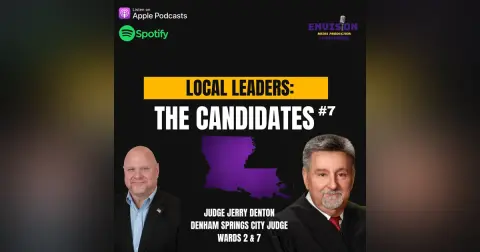
Local Leaders: The Candidates #7 | Judge Jerry Denton - Denham Springs City Judge Ward 2 & 7

 Apple Podcasts

 Castro

 RSS Feed
In this episode Jim Chapman sits down with Judge Jerry Denton, who is seeking re-election as Denham Springs City Judge Ward 2 & 7. Judge Denton goes into detail about his lifetime in many different roles including as a homicide detective, a city councilman, a city marshal, a current Judge and even a stint early on in his life working both offshore. Judge Denton also gives a glimpse into what it was like to take office as city court judge immediately shortly after the flood of 2016 and the day to day as a judge for wards 2 and 7.
You can learn more about Judge Jerry Denton by visiting: https://www.facebook.com/JerryDenton4Judge
Timestamps:
00:45 Bayou Cane Roots and Small-Town Memories
02:31 A Young Man’s Path to Law Enforcement
05:33 Leaving Home and Building a Life
10:11 Offshore Work and a Brush with Danger
17:12 Finding His Calling in Policing
21:25 Working Full-Time While Earning Degrees
26:28 Undercover Work and Its Personal Cost
33:53 Law School, First Trials, and a Legal Career
39:25 Taking the Leap into Private Practice
44:24 Entering Denham Springs Politics
50:54 Building the City Through Major Projects
53:54 Becoming Marshal and Expanding the Court District
1:08:20 Adjusting from Marshal to Judge
1:11:44 Becoming Judge and Facing the 2016 Flood
1:17:34 The Flood’s Lasting Impact on the Community
1:20:47 A Judge’s Record and Reelection Bid
1:24:15 The Campaign, Court Docket, and Judicial Standards
Tags: Jerry Denton, law enforcement, legal practice, local government, Denham Springs City Court, court modernization, docket management, 2016 flood, community service, reelection campaign, Judge
2:27 Hey, everyone. Welcome back to Local Leaders, the podcast. And happy to have on the show today, I guess you could call him a local legend. He is Judge Jerry Denton. He is seeking reelection to the city court judge of Denham Springs, Louisiana, in Wards 2 and 7. So first of all, Judge Jerry, welcome to Local Leaders, the podcast. Thank you very much. Thank you. Glad to have you on. Your first appearance on Local Leaders. So I'm excited to take the listeners and viewers on a little journey of your life. This is your life. You remember that, Shea? I do. I remember it well. This is going to be the Judge Jerry Denton version.
3:09 That obviously starts off with where you were born and raised. So tell me a little bit about that. I was born right outside of the town of Houma, Louisiana, the city of Houma at the time. It was an incorporated municipality in a little community called Bayou Cane. Yes. And so it actually is interesting. I grew up, it was pretty much, it was kind of rural in the country. And now Bayou Cane sort of became the center and the hub of Houma. in that area, what they called the third ward, which is probably the largest ward in the whole parish. And geographically, it's probably the largest in population-wise.
3:53 And that's where the mall went and all the stores. And the town just sort of moved that way. And when I was growing up, I mean, everybody went to town. for Main Street where they had all the old stores, you know, Richard's Variety Store, Woolworth, and all that. They even had the Woolworth counter where you could go eat lunch. Yeah. And the courthouse was downtown, and the central hub, everything revolved around downtown. Similar probably to how Denham Springs was way back in the day with what we call the antique village now. Yeah, that's what it feels so much like home to me, you know, in that way becauseâ You know, and you had to be a Western auto down there. We had a Western auto in home and that was like one of the coolest places to go. My grandfather had not only had all the tools and everything else, but they had bicycles and all kinds of neat things like that.
4:45 Yeah, that's right. I forgot they had those. I remember those days as well. So you grew up, small town, similar to where you're at now. Yes, sir. And at some point, you go to college. Yes, sir. What happened was I left home at 17 when I graduated high school. I was probably the youngest one in my class, and I missed the draft for Vietnam for about 90 days. Oh, wow. If I'd have been born when my sister was born, I'd have been gone. But she was born first, and by the grace of God, and alsoâ I went and visited with my father, and I went to the Marine Recruiting Depot down in New Orleans. Back then, they had a place called the U.S. Customs House.
5:34 Yeah. And that's where they would do the physical and induction. So I went down there with the gunny sergeant and a van, and he took me and a couple other guys down there. We went through everything. And then I, of course... My interest in law enforcement was still there. My grandfather was a deputy sheriff, and my great-great-grandfather was a sheriff of Terrebonne Parish. Okay, did not know that. And so I thought, you know, I'd love to go into the Marine Corps. And being 17, my mother, she had to sign. Back then, both parents had to sign. It may still be that way today. If both parents are alive, both have to sign. And my father, after talking to counseling with me, he said, I'll do it.
6:23 That's what you really want to do. And my mother, I mean, she said, I'll die before I sign that piece of paper. She said, I won't. She said, I'm not doing it. And I could tell it was really trouble to break her heart. But I went down there and did everything, pastor, physical. And so I wanted to be an MP. Okay. I was hoping to get embassy duty. That was what was interesting to me. Yeah? And so there was a cutoff of 5-8 for the MPs. Yeah. And the only way that you could get that waiver was you had to go to Jackson Barracks and the general there. And my dad said, don't sign anything, son, unless you have it in writing. He said, you know, take it from an Air Force veteran. Don't do it.
7:11 Don't sign. So. And, of course, at that time, you know, it was probably fine because at 17 I wasn't able to contract. So I had to be 18 to contract. And how tall were you? I was 5'7 and half. Oh, you were right there. I was right there. Yeah. And the general could give a waiver. And so I went to Lakefront Airport, and he signed a waiver, and he was going to allow me to go into the MPs. And he said, no, you still have to pass all the training. But he said, I'm going to give you the opportunity to do that. So I went home, talked to my dad some more, talked to my mom. And my mom said, I don't care if he makes you the chief of the Pentagon.
7:51 You're not going. I'm not signing. You're not going. I'm not doing it. She said, you're too young. I'm not doing it. And then, of course, inâ Then, thank goodness, after that, in the Paris Peace Talks and all that started and occurred and it was ongoing and Kissinger was able to get a resolution to that. So I left home at 17. I thought at that point my parents had done all their job. They raised me. I didn't want them. I never knew if we had money or not. They had two other kids and I thought, well, My sister's married and moved out. My brother's home. I probably need to move, you know, and take the burden off my folks. So I went and moved. And back then, 1976, 75, there was a guy named Mr.
8:48 Guidry. And he had this rent house. And I got it for $ 90 a month. It was 800 square feet. Oh, wow. And we had that house for $ 90 a month. And now... It was just a handshake. He did no contract or anything like that. Yeah. And he lived right next door, and he had a big garden and everything. He planted and all that. But he said, look, he said, he said, you can pay me between the 1st and the 5th every month. And I shook hands with him, and I drove away from thinking, how am I going to come up with $ 90 every month? Every month. Imagine thinking that now. $ 90. Yeah. Yeah. You know, and so I said, well, I'll, I'll figure out something, you know, and, and so, yeah, it was, and then, and I lived there for about four or five years, and, you know, I got married when my, my, then my wife moved in with me, and, you know, and then one day he came to me, and he looked pretty forlorn, and I was like, well, what's the matter, you know, Mr. Giddy, you okay? Oh, I said, Jerry, he said, the insurance is going up, he said, I'm gonna have to go up ten dollars on your rent, he said, I, I feel bad about it. I said, Mr. Gifford, it's okay. It's all right. It's all good. By that time, I was working for the sheriff. office. I was making that big money. $ 342 clear every two weeks.
10:06 Yep. Boom. I'm going to cut this out real quick because they'll hear when he opens the door. I'm going to use the restroom real quick anyway. Mr. Jerry, I didn't even ask you if you wanted some water. Oh, you got some. You're good. Jump to the restroom real fast. I should have done that before we started. As soon as we started going, I'm like, ah, that's how it goes. I'm getting old. I'm getting up there. I get it. Everything okay, Dwayne?
11:04 Brady's having some serious abdominal pain. Oh, Lord. Didn't he have that not long ago? Yeah, remember? But he was running that day. Remember, I thought he was okay. So he's headed to the hospital in Hammond, and Tony's headed there to go. Oh, okay. Do you need to go, Dwayne? No, I don't think I need to go. It's a shame. That boy's going through that. My 19-year-old's having some serious abdominal pain. He lives in Hammond. He goes to school over there. I'm going to stay out here just in case they keep calling. Yes, sir. Okay, Dwayne. All right. Sorry about that. No problem. It's all good. All right. So where we left off, you were... Um, you were renting a house for $ 800.
11:52 Or $ 90. Yeah. Nine, $ 90 a month. And then he, and then after about five years, he had to go up $ 10 a month and, uh, at $ 120 a year. And he, he, he, his, his conscience and his soul was bothering him having to go up on me. Uh, it was really good because they were elderly and, uh, we always checked on them and, you know, looked after them and stuff like that too. Um, They had a spinster daughter that lived with them, but she was also, she was up in age. When I moved in, Mr. Guidry was probably close to 78 when I moved in. Wow.
12:33 He retired from the city. He was a city engineer, as a matter of fact, in the city of Houma. Wow. Yeah. And we had something unique down there in Houma. We had a tunnel. Really? We had a tunnel, like the Harvey Tunnel and the one in Mobile. Well, and my grandfather was good friends with Senator Allen Ellender, and they had a camp together, and they duck hunted in their camps and all. Then they had separate camps right across from one another and stuff. As a matter of fact, they are buried right next to each other in their home. Senator Ellender's right there, and my grandfather's right next to him. And on Senator Ellender's, it's really always thought it was cool. It has a farmer... lawyer, statesman.
13:21 Oh, that is awesome. Yeah. And, you know, dates of birth and stuff like that. That is awesome. It was like 1899, you know, whatever. Yeah. But, yeah, so it was really just kind of neat. I had a tunnel. Do they still have the tunnel? Yeah, it's still there right now, as a matter of fact. But now it's a two-lane tunnel, you know what I mean? It's just, it's not a very wide expanse. It goes right under the intercoastal canal. Thank God we have that. You know, we had the bridges. We had one that turned to the side and rotated, and we had the ones that draw bridges like that. And we had idiots that we had car chases over who tried to do something.
14:02 Jump it. Yeah, we had morons that really actually tried to do that. And, you know, we'd always call ahead and bridge tender. Boat traffic always had paramount importance with the one exception of emergency vehicle traffic. Yeah. Life's in danger or something like that. And we'd call ahead and they'd say, is it open for gators or open for land vehicles, you know? And so they'd say, you know, the bridge tender would report back to us through the radio operator and they'd say it's open for y'all to go through. So we would do that. But the tunnel, I tell you about that because it's really interesting. And it was a very unique thing when they built it and all. And my grandfather was the superintendent of that for 30 years.
14:50 Really? Yeah. Wow. He ran the tunnel. I think Senator Allender sort of helped him wind up with that position. That is interesting. And he was very mechanically inclined, and there was a lot of things that had to be done and vows and different things all the time. Sure. And he was really good with that sort of thing. And, I. Mean, it's still there today. You can go through it, but. And it was really a lifesaver because it brought the east side and the west side of the parish together. I mean, it was an alternate route because the hospital, the only hospital we had at the time, was Terrebonne General, and it was on the west side of town.
15:31 Okay. Wow. Interesting. So at some point, you get out of there, you go to college. Yeah. I was working offshore. for Warren Automatic Tool Company. And they sent me to school in Houston for, I don't know, I guess it was 8 to 12 weeks. And they sent me, and I was a service technician for mud engineering equipment. Okay. And so I worked close with the driller and superintendent. That's serious work right there, Judge. Yeah, I mean, I was really young, too. I was just made 18 years old. but they didn't have no openings at the sheriff's office. That's where I really wanted to be, so I took the job offshore. And so I'd go to work, and I was on a 24-hour call every other week. And here I was, 18 years old.
16:27 I had a company truck, credit cards, and all sorts of things for the company, a lot of responsibility at an early age. And they'd send me out on these rigs, you know, land rigs in the middle of the night, four or five miles into the swamp on a board road. And, you know, just me and, you know, just there, going out there, you know. Yeah. And you couldn't have weapons because there was no firearms allowed on a drilling site. Okay. So, I mean, you just had to go and take your chance. And the bad thing is if you got down there and there was somebody coming out, it was a one-lane board road, somebody had to back up whoever had the least amount of distance. Oh, no.
17:10 Wow. And especially if it was an 18-wheeler coming toward you in that, you know, because we had no communication. We had no cell phones. We had none of that sort of thing. Yeah, that's true. And then you would drive back on the board road, and then all of a sudden you'd start seeing some light, and then this great vista would open up, and there was your drilling rig, you know. And my job was to run tubing from the drilling floor all the way down and underneath the rig and all the way down through into the mud tank. We had something called a mud graph on the flow show, and these were meters that were up there by the driller so he could tell mud pressure and gauges and know what they needed when they were going downhole to determine. And the drilling fluid, which allowed for the casing in the rotator to turn easier, it was sort of the lubricant for the pipe to go downhole. He called it tripping pipe. And that was each one of those stands was 90 feet, and a guy worked on a monkey board up there. And he would swing out. He had a cable on. He'd swing out.
18:11 And they'd do the pipe. And you had three guys on the floor. And they had the tong. And that thing would spin around. I mean, it was one of the most dangerous jobs. I was down there. And the tool pusher, the driller, and the superintendent, and the company man that day who was that guy. The company man was like God. I mean, you knew who he was because most of them wore a nice cowboy hat, expensive beaver 10X hat. Yeah. Nice, expensive, exotic boots. Starch pants. Nice shirts. Cigars, generally, they were big shots. I mean, when the company man was on the rig, it was like God was there, man. You had to do everything right. And so I was hooking up this meter, and my pants had come untucked from my boot, and it got caught in the chain.
18:59 And so, obviously, if it would have... Wrapped up in there. It would have crushed my leg. Probably my femur killed me, you know. It probably got out because we were way out there. And it was a gold rust drilling rig. And the tool pusher happened to see what happened. But I didn't know what was going on because I was concentrating on what I was doing. And he saw. And he came with both fists, pushed me as hard as he can. And he knocked me on my butt. And I got up ready to go back and hit him. And he went. And the other guy said, hey, man, he just saved your leg, if not your life. He said your pants leg was about to get caught up. And he said if it wouldn't have been for him knocking you on your butt and tearing your clothes, it was a coverall. You know, it was like yeah oh yeah a coverall we had a blue coverall and and it just came out of my boot uh safety toe boots and uh and but it was about to get caught in that chain and he saw that and man he just knocked me on my butt knocked the wind out of me.
19:56 But holy cow yeah yeah that would have been bad. Yeah so and then and i was like yeah you know and then i'd fly on helicopters uh a guy that was kind of adventurous that was fun I was on a boat about 14 hours, got real seasick, had an old captain. I think we were on one of the Schwest boats at the time. And anyway, the old captain, he said, it was an affectionate term. He'd say neg, you know, which just meant, you know, like little one. And he was just a young boy or whatever. And he said, now, you're looking a little green around the gills. I said, yeah. You know, I'd been on the boat at that point about eight hours. And I was, man, a little seasick. And so he said, reach down in that drawer. He said, I reached down in the drawer.
20:47 He pulled it open. And he had a bottle of Evan Williams. And he said, take a shot of that. He said, see those crackers? He said, get you a handful of them crackers. I did the thing. And he said, chew on those. And he said, you go down below deck on that bunk. And he said, you put your feet, your face next to that vent. And he said, you breathe in that cold air. And he said, you're going to be all right. I went and put my face against that vent. And next thing I knew, I woke up at the dock. No kidding. It worked. Yeah. That old boy knew what he was doing. Yeah. But from that day forward, they got a boat going in.
21:28 or you can wait six hours and get a PHI. I'll take you back in a helicopter. Back then we had a PHI and air logistics. Yeah. And he said you can go back in a helicopter. So every time they gave me a choice, I took the helicopter. If I was 200 miles out, it didn't matter. I said I wanted to go in a helicopter. I said because that's going to be a quick death. The other way was hard. I said I never want to go through that again. At least a helicopter, if I survive, fine. But if not, it's going to be a quick death. I won't be that much pain, and I'll be over with, you know. But I enjoyed that. It was terrific. It was fun. Learned a lot. And during that time, well, there was a gap. There was a gap before I was able to get on with the sheriff's office. And it was right before they started doing post-certification, which we wound up having to do that starting in 1982. And I started in 1977 with the sheriff. Okay. So... What happened was we went toâ they went to 10â the shifts were 6 to 2, 2 to 10, and 10 to 6 in the morning. 10 to 6 in the morning was graveyard shift. Yeah. And so I went on and so between the time I got to go to work for them and the time that I was able to get onâ and I leftâ one automatic I was like I had enough I was like I don't want
23:01 to go offshore anymore I was driving to Venice and it was just it got to be kind of tough on me it was wearing on me working on the rigs and just I was on one there one day I was on there and a guy dropped a tool from the top and I mean it just went right by me and I was on another rig and a guy that I'd been working with that day He got killed that afternoon. And it just, it was like, I don't know if I want to do it. My grandfather spent 35 years with Texaco working six and six back then. They allowed him a day for travel. Yeah. And he went to work for them when they were the Texas company.
23:42 Yeah. Oh, yeah. You know, and so back in the 30s. That was, yeah, that was. And so then they became Texaco, the giant that they are now today. Yeah. And, but. Yeah, but I was like, you know, I think I'd rather dodge bullets and dodge tools and 50, 90-foot stands of pipe and the possibility of the drill and rig explosion. I mean, it was really good. It was interesting where it was fun. But my heart was really in law enforcement. I really wanted to be a police officer very bad. I wanted, you know, I had that burning desire for public service and to work, you know. Yeah. And so. I drove an 18-wheeler for Walker-Romer Dairies for several months waiting to get on with the sheriff's office. And I was a relief driver. I drove Wednesday nights and Saturday. And what I'd do is I'd take a load of empties from Homer to Metairie.
24:38 And I'd leave about 9 or 10 o'clock at night and I'd get back at about 2 in the morning. And back then they had home milk delivery, and they'd deliver bread and milk and cheese and all sorts of things like that, eggs. And they would deliver all that home to your house and put it on the steps. And, you know, you'd just pay a bill every month. People trusted you, and they paid. Yeah, I remember. I remember those. Days when I was a kid. My grandmother got milk delivered in old milk bottles, you know, to her house. And so I drove the 18-wheeler for them. and so then I went to work for the sheriff's office, um, the first month I spent as a, as a dispatcher learning everything, they put me through that, uh, then I went, uh, into patrol, and I was in patrol for probably about, uh, I don't know, I'd say probably a little under, a little under two years, and an opening came up in the detective bureau, um, and so I said, you know, I really wanted that pretty bad, and, So I was fortunate enough to be accepted and got in there. And, of course, that came with a vehicle.
25:52 Sure. So back in that day, we only had one car to share, my wife and I, you know. So that came with a vehicle, so it was nice. That was a huge plus, yeah. And then being on call. And back then, the rules were a little bit more generous. The sheriff, he had dictated policy, and he said, you know, I want you guys to always be available. I don't care for what it is. So if you've got to go to the store, you've got to do something, go in your unit because if you get called or something goes down, I want you. He said, because you've got a 24-hour-a-day job. You don't work 8 to 5. You're not a banker. He said, you're a policeman 24 hours a day. Don't forget it. I said, okay, cool. So I had a car. So then, you know, my whole goal was to go to school, but I was going to try to go to college at night. Yeah. And I went and talked to the sheriff, and I went and talked to the chief of detectives and told them I really wanted to go to college.
26:44 And nobody back then, they didn't really go to college. The guys just, you know, they went to high school and they worked. Yeah, what do you want to do that for? So I said, okay, you know. And they said, well, I said, and then I went to school, found out I needed, if I was going to graduate within 20 years, I had to go all day long. So I went. talked to them, going to Nichols, which was about 16 miles, and the sheriff got me commissioned in the other parish too so that I could utilize my vehicle and be on call for that sheriff as well and keep everything legal and justified. And so I went to school 4 to midnight. I mean, I went to school 8 to 4 They put me on a four-to-midnight shift, and I worked four-to-midnight for seven years. And the only thing is I would get K-time, and they would let me work.
27:53 They'd come in and work extra detail for the sheriff's office. They'd give me off the time. So I kept my job at Walker Roamer, and I drove on Wednesday nights, And it didn't impact anything on Saturday because we didn't work on Saturday. We worked Monday through Friday as detectives. Yeah. So I kept my job driving the truck and went to school and kept my job as a detective. I went to school for seven years. I would go to school, usually get to school about 8, 8.30. And then by 2, 2.30, I was off. And I was always 10.8, which was in service. Yeah. On the road, and I'd go to work at four. I mean, I'd go to work dressed to go to work. I mean, I was young, full of energy.
28:40 Yeah, you didn't need no sleep, apparently. I mean, and that's exactly what I did. I'd work on the function and sleep. It was always tough, though, because every time I was going home, I'd get home, my lieutenant was real nice. He'd say, hey, look, and if I had a test coming up or something, he'd say, look, he said, you can stay in the office, and if I need you, I'll call you. He said, if we get a call, listen to your radio. He said, but you can study. I've had an exam coming up. He'd really be nice. He was nice to me. He went through the 11th grade. He never even graduated high school, my lieutenant. But he understood how much I wanted an education. And no one in my family had ever gone to college. As long as as far back as you can go, no one ever got it. And so I wound up in 10 years, including law school, I got three degrees in 10 years.
29:30 Well, you made up for everybody. I mean, that's amazing. Wow. What were the degrees in? My first one was in, obviously, criminal justice. Yeah. The second one was in law. was in government and business. Okay. And then I was about, when I got accepted to law school, I was working on my MBA, and I just needed about 12 hours to finish up my MBA. Yeah. And at that point, I got accepted to law school, and I was gone. You were gone. Didn't have to ask you. And what law school was it? I went to Southern. I was very fortunate. I was able to go to Southern and LSU. We had a hybrid program back then. You could take where your first 60 hours came from, that's where your degree would be.
30:13 And we were able to take classes at LSU, what they called cross-training, cross-referencing classes, and you could take. every semester you could take six hours at LSU and you could take your hours, uh, at, at Southern. And so I took advantage of that because there were so many great professors at LSU. Um, and what happened was I was, uh, applied to LSU and when it came time to take the LSAT, I got pneumonia and I wasn't able to take it. And so the only school that was left open at that time, um, because the registration closed off in February for LSU, and then at Southern it closed off for March. So I was able to make the March deadline, and I got in, and then I came and moved up here, lived up here by myself until I could get my family. Because like I said, I had a wife, a baby, and a mortgage. And that's another thing. Of course, I don't know, I guess sort of jumping around, but And during my time as a detective, I worked major felonies and misdemeanors as well. But I spent two years undercover. And my son, when he was about three, I guess two, so he was still small.
31:44 And I spent, of course, he was born the first year. And when he, I was undercover when he was born. He never saw me without a beard or long hair, earring, you know. So that was dad for him. He never saw me any other way. And so I guess about two, two and a half, maybe not quite three, and I came home that afternoon. I'd been asking him, you know, I was kind of getting where the line of separation wasâ you know, starting to blur as to who was the good guys and who was the bad guys. So I went in and I saw the chief of detectives and chief of narcotics and I said, y'all need to pull me out. I need, I need to get out and I don't feel, I'm not comfortable anymore. And I said, I got that little boy at home and I just, and I'd been a couple of times in some bad situations where they had put me on my knees. The Guatemalans and the guys from South America, uh, I was in a hotel room and they put me on my knees and put a 45 to the back of my head. And, you know, they said, you beg for your life because we think you're a pig. And, you know, and I was like, I'm not, I'm not. And, of course, what they didn't know, there was a whole SWAT team in this side of the hotel room and a whole SWAT team on that side, you know. And the deal was make the buy. And then I was supposed to go out and put my hand through my hair. And that was the thing. They were going to crash in the doors and take them down. And I had another bad experience.
33:11 And they beat me up pretty good and put me in the back of a car. And I thought they were driving me somewhere to shoot me. And, you know, it was like my nerves were pretty shot. At two years. Wow. I was pretty, you know, I said, y'all got to pull me out, you know. So they let me go back in plain clothes. So that day it was really neat. Back then the barber could shave you. He got shaved with hot shaving cream, and he used a straight razor. And I got my hair cut, and I was cleaned up. I had a nice suit on. And back then, I carried a Rogers rig underneath my arm, my gun under my arm, my handcuffs, and an extra set of pouch of bullets. Back then, we had a revolver, so you didn't have clips or anything like that. I had speed loaders. So I'd carry my speed loaders. And so I went home that day. I had my nice suit on and my nice shoes. And they'd give us outfits twice a year to detect us. They'd buy us spring outfits and they'd buy us summer wardrobe. And so I had my clothes on, my nice suit, and I was walking in there. And my son's name's Jerry Denton III.
34:13 So I said, hey, Trey. Man, he was sitting there watching the Dukes of Hazzard reruns, and he had a little bowl of dried cereal he was eating. And That cereal went all up in here. He took off running. He went behind his mom's leg, and he was holding his mom's leg. He had no idea who you were. He was like, I know the voice, but I don't know who that man is because he had never seen me clean shaven, and I didn't realize that it was going to be such a dramatic thing for him. Yeah. And it took about two weeks for him to warm up to me. It just really broke my heart because, I mean, it was like, golly, I just wanted to embrace him and be around him. Sure. He was very standoffish at first, and then he realized, We got pictures. Said, look, this is daddy. This is daddy.
34:55 And finally heâ and it was okay after a little bit, but at first he just would notâ he was scared of me. Wow. And I looked normal then. Yeah. The bad guy. He wasn't scared of that person. No, he wasn't afraid of him at all. The clean cut Jerry. Yeah, he was like, I don't know that person. Wow. My wife was a nurse at the time, and she workedâ three uh seven to three sometimes in three to eleven so it was just we just i mean we we had a very uh busy and very interested in life and and then went to law school and uh and i would look i was sitting there and it was august and i couldn't believe it uh that about that time they had a show called the paper chase it was on tv it's about a young guy who from a farm and and he went to law school in harvard And, of course, I was called to paper chasing.
35:54 I had this professor, Kingsfield, who taught contract law. And it was a great show, and it was very inspirational for me. And I was like, man, you know, of course, my dream in my whole life would have been able to, we couldn't have afforded anything like that, but I would have loved to have gone to Harvard. Yeah. I don't know if I would have been able to even get in, but it's, you know, basically uniqueness. I said, well, gosh, if there's nothing more unique than a Cajun, That's right. So it was fun. Went to law school. But, I mean, I was there for the first three months. I couldn't believe it. I had to pinch myself. I was like, I really got to go to law school. This is awesome.
36:36 And they couldn't have made it hard enough for me. They said, Jerry, every day you got to go and scrape the gum off the floor if you want to stay here. And I'd have done it. I'd have done whatever they needed me to do to be able to stay in school. and to go to law school. And I knew how much of a privilege I had and how lucky I was to be there. And I was about two years older than the average students that I went in with because of my time working and all. And it took me a little bit longer to get through college and working full time. And it never failed. I'd try to get home for 12 o'clock at night, and sure enough, there'd be a drunk, and I'd have to pull him over.
37:18 Yeah. And quite often I'd bring them home if I could. The only interesting thing that really ever happened that one time, I got an old boy and I said, oh, man, and I was so tired and I had a test the next day and I knew I needed to get to school. But he just kept crossing the line, kept crossing the line. I said, if he crossed it one more time, I'll pull him over. Crossed the line. I was like, ah. So I pulled him over in the parking lot and he said, oh, man, I was almost home. He lived about, I guess, about three blocks down the street from where we were. And I said, okay. I said, I'll tell you what, buddy. I'll tell you what. I said, let's lock your car up. I said, you go sleep it off tomorrow. Somebody will come pick you up. And the sheriff gave us that kind of discretion, you know. Sure. And so I said, okay. So he gets in the car, and I'd frisk him and everything. And I knew he was just a good, hardworking guy. And I kind of knew he lived in a nice neighborhood and all. And I said, look, you can ride in the front seat with me. I didn't cuff him or anything. I brought him in the front seat, let him go down. I pulled up in the driveway. The light, porch light comes on.
38:17 And this lady's standing at the door like this, her hair's in one of these things, and she's looking like that. And he looks over at me and he said, could you bring me to jail? I said, no. I said, you got to face the music, buddy. I got to go to school tomorrow. You go in there and face the music. And I said, I better not hear that on the radio. There's a domestic call here in an hour. That's a great story. So you, you do, you eventually, you graduate from law school. From law school. Yes, sir. Uh, I tell, I tell, you know, it's kind of funny. Um, um, You know, we started out with 243 students, and we graduated 99.
39:00 Wow. And so I always tell them, I say, I graduated in the top 10 alphabetically. Alphabetically. I don't know. I really don't remember where I was. I was probably in the top half, but it wasn't that. It was important to me to graduate. That's right. I'm aware I graduated. That's right. I said, you know, and I tell my dad, you know, My dad said, you know what they call you know, the doctor who graduates last in his class? I said, what? He said, doctor. That's exactly right. Yeah. Yeah. So, you know, and I really don't know who, I know who was first. I don't know who was last. Yeah. But I do know the first, the guy, as a matter of fact, it's Supreme Court Justice John Guidry.
39:42 Oh, really? Interesting. Yeah, he was in my class. I had a class of real overachievers, man. I'm talking about John Michael Guidry. Supreme court, Congressman Cleo fields. Um, there, um, lots of judges, lots of judges from my class, uh, lots of state representatives, senators. We had the most politically active class that probably ever came out of that school. Interesting. Well, you get out of there and it's time to, it's time to start lawyering, right? Yes, sir. And then I came, I interviewed for a firm, came up to work up here. Um, the guy told me, he said, um, You know, I got 20 guys to interview.
40:23 And he said, this is a very competitive job. The firm is a very nice firm. They have since disbanded. All the old partners passed away. But anyway, so I was in his office, and he was a real taskmaster of a guy, you could tell. And so I looked around, and I watched what he had on his walls. He had some Ansel Adam prints. And he had a lot of ducks, pictures of ducks, and some hand-carved decoys of ducks and different things like that. I paid attention to that, okay? And I'd always kind of been in the habit. My parents sort of brought me up like if an old aunt or somebody sent me a present from my birthday or whatever, they'd say, you need to send them a thank you card. We always had thank you cards and stamps, so I was always in the habit of writing notes. So...
41:20 um did the interview they brought me back for a second interview after they called it down to about seven of us and between the first and the second interview i happened to be walking through dh holmes yeah and dh holmes uh had a set of uh susan b uh i mean it was susan. Susan b anthony no let's see what was. It susan anyway it's from colorado uh It was embossed, beautiful cards, Blue Mountain Arts. Okay. Blue Mountain Arts. Susan something, Collins maybe or something, Susan like that, similar name to the senator from New Hampshire. But anyway, so she had these beautiful cards where they had this pack of 10 and it had these beautiful wood ducks on it, embossed and had gold. And it was really, I mean, they were really fantastic. So I said, let me pick up some of these. So I got that.
42:15 I went home. And I wrote a thank you note to him, you know, noticing those ducks that he had an interest in that. And I wrote a really nice thank you note to him, thanking him for his time, thanking him for interviewing me and told him I would be very honored to have the opportunity to come to work for them. And three days later, I get a phone call from that guy and he said, hey, when would you like to start? And I said, you know, this is probably Thursday or Friday. I said, Monday. Would that work? And Of course, I didn't even know I was going to live or anything. He said, yeah. He said, Monday will be fine. So after several many months of working there, he said, let's go to lunch. So we went to lunch. And I got to talk with him.
42:56 And I said, Len, I said, Mr. Thompson, I said, why did you hire me over all those other guys? He said, two reasons. He said, one, he said, you paid attention to detail, obviously enough to know that I like ducks. He said, you sent me a wonderful note, and it was a beautiful card. And he said, I went home and told my wife, I'm hiring that young man. He said, I'm going to tell you right now. He said, 20 of them I interviewed. I got one thank you card, and it was from you. There you go. There you go. It makes a difference sometimes. You stood out. And then he said, I went and told the partner. The partner said, I don't know. He said, he talks funny. He said, he doesn't sound like he's really smart. He said, you know. He said, he's a Cajun. He said, they all talk like that. And he said, I don't know.
43:45 He said, I tell you what, boss, let me hire him. If he doesn't work out, I'll fire him in six months, okay? And the senior partner said, okay, he's your responsibility. And by the time the six months was over, I was settling more cases in the office. And the senior partner came in. He said, I sure misjudged you. He said, I need to ask your forgiveness. He said, I wasn't in favor of hiring you. And he said, but Lynn believed in you. And he said, I believed in Lynn. Yeah, that's awesome. So I worked for them for a little over a year and a half. And I don't know what made me think that I could do this, but I had six months of my mortgage paid up. I had six months of money for rent, and I had $ 600 cash in the bank, and I went and opened my own law office.
44:34 There you go. Went out on my own, and I built that law office intoâ But when I left, I had five lawyers, two paralegals, three secretaries, and an investigator. Wow. Very good. And I had to make $ 20, 000 a month before I took a dime home. Yeah. Very good. That's the way to do it. But I didn't know enough to know that I couldn't do that. Right. No one ever told you you couldn't do that. I was just like, oh, this is what you do. You went in and do it. So I opened up that office, and it was really wonderful because I guess the good Lord had his hand on my shoulders because withinâ Six months of opening that office, I settled a case. And my dad had given me a Rolex watch when I graduated from college.
45:19 Yeah. And a stainless and gold Rolex watch. And, of course, I didn't have lines of credit or anything like that other than my mortgage at my house. But I didn't know business. I wasn't that savvy. I was just still a pretty young kid. I was probably 26, 27 maybe. And soâ The client needed money, and I was like, I don't have any extra money. So to finance the case, to file it, back then it was probably like $ 300. To finance the case and to give the client a little bit of money, I went and pawned my Rolex watch, and I made payments every month, paid the interest payments on it every month. And within about six months, I settled the case for $ 50, 000.
46:04 There you go. So the first thing I did was I went and. Recovered my watch. Got your watch back. Got my watch back because I was so worried about that because I was like, my dad would be so disappointed in me. I don't know if I ever told him that, and now he's passed, but I don't know if he ever knew that I did that because I was kind of ashamed. But it was like that's the only thing I had of value, and I needed to be successful, and I needed to make this work. So I pulled my watch, got my watch back, and made some money, put that money in the bank, and then I started selling some more cases. And then the next thing you know, it was just up and running, and I was having to hire additional people. And then I got a very lucky break in about 1993, open office in 1990. 1993, I wound up with about 1,100 clients in a Nexon suit. Oh, okay. Class action suit.
46:53 Yeah. And that's the thing that sort of propelled me and got me on my way. Wow. And then I went to workâ Matter of fact, I retired the first time at 39, and I spent about two years living at Global Wildlife. Okay, yeah. It belonged to a friend of mine I graduated with, and he put me on the board of directors, and I was the corporate attorney for them, and I pretty much lived up there at the ranch, and we rode motorcycles all over the place. And then around probably about two years after that, I was missing the practice, and I wanted to go back to work. I missed being in the courtroom. I loved being a lawyer, and I wanted to get back in the courtroom.
47:38 Sure. And so I told him, I said, look, I'm going to go back, and I came back, and I opened up an office in Denham in 2000, and private practice again. And the thing about, I had been practicing here since like 1990, And a lot of my clients came from Walker and Livingston and Watson and Albany and French Settlement, Port Vincent. I was noticing my clientele, that's where they came from. They only had 10, maybe 10 or 11 lawyers at that time in Denham Springs. Yeah. So it was a really great market. under-serviced market, you know, this is like, I mean, where are you going to find a place where they only have like 10 or 11 lawyers?
48:25 Absolutely. Not bad in origin at that time. And the growth potential was tremendous. Sure. You know, I saw the future here. Yeah. And so my wife and I settled here, and the first night we slept in our house, June 14, 1997, I built a new house on an acre of land, about a 2,400-square-foot house, really nice. And to be very honest with you, I can't imagine that I was able to do that. That house and the acreage, and it had nice upgrades. I built that for $ 137, 000. That's unbelievable. You couldn't get the land for that hardly these days.
49:05 And the people that bought it, they sold it 20 years later for almost $ 300, 000. Yeah. Yeah, that's a heck of a return. Yeah. Unbelievable. Well, you. Run that practice. And at some point. now you get involved in Denham Springs pretty heavy, and at some point you decide I'm going to run for city council. Yes, sir. I immersed myself into the community, and I was doing a lot of volunteer stuff, and I was like, you know, I went to see Mayor Jimmy Durbin, And I said, Mayor, I would like to run for the council. And back then, there was a lot of good old boys. I mean, they were well-entrenched and stuff, you know. Sure.
49:46 And he said, well, I'd love to have you. And, of course, we were different ideologically. He was a Democrat and I was a Republican, but he was a moderate Democrat. And I was a pretty strong, you know, straight Republican, Republican, Republican. Right. And I loved Ronald Reagan, and so. And to me, that was the way to go. And when I grew up, though, I mean, you know, like your grandpa would take you down to the registrar of voters and say, you better sign up Democrat. Yeah, oh, yeah. There was nothing else, you know. It was a worker man's party back then. And then as soon as I was able to do that, and, of course, the first election I voted in was in 1976.
50:27 And for president, the first time I ever voted, And I've voted consistently all the time. I don't know that I've ever really missed any votes. I may have like a drainage issue or something like that. I don't really know. But I'm a very dedicated voter. I've always believed in that. I thought it was such a privilege and it was so great. I was so excited the first time I got to vote. It was like so cool, you know, to get to participate in the process. And so I went andâ And, of course, like I said, became a Republican, and I was a young man. My grandfather had passed away by that time, so he probably was okay with it, I suppose, you know. Yeah. But, you know, I was probably the first Republican in the whole family, you know. Yeah.
51:19 Because everybody else. Well, and I mean, back in those times, Judge Jerry, you know, the unions were controlled byâ I meanâ the democratic party controlled the unions and the, and all your iron workers, all your, yeah. You want it to work? Oh yeah. You know, you had to toe the line. A hundred percent. So, uh, and, and so anyway, I visited with Jimmy and, uh, and he said, well, I'd love to have you, you know, he said, we need some new blood on council. We need some, you know, and, and, you know, the fact that you're a lawyer and you're educated guy, he said, he said, we need that. The end of screens is growing by leaps and bounds. And he said, I'd love to have you. And, and so, Believe it or not, I garnered his support, even though we were ideologically somewhat opposed.
52:03 I said, I think you need some help, Mayor, and I'd like to come to work to help you as a councilman. So I went around and did the old thing, saw all the good old boys, visited with them. And he said, you know, Jerry, we like you. You're a good fellow and everything. But he said, you know, you didn't marry a girl from Denham Springs. You're not related to anybody here. And moreover, he said, you know, you didn't graduate from Denham Springs High School. I mean, that's like the mark. Yeah, what do you think you're doing? You're in or you're out. You've got to go to Denham Springs. And I was like, you know, I'm sorry. I mean, I didn't have the privilege to go to Denham Springs High School, but I sure wish I had. And they were like, but we want you to run.
52:44 Some of them said, we can go for you. But a lot of them said, look, Jerry, I don't want you to get discouraged. I said, you might. take you a couple times but you're gonna get there eventually he said you're a likable fellow you know you're a good guy um you know don't give up even if you don't make it this time yeah do your best and run again run again because we're gonna help you yeah and and so i said okay so this was like the think tank of james grill i used to call it the think tank the think tank that was like a You know, the Brookings Institute of Denham Springs, you know. Right. So I go over there and I visit with them.
53:25 And sure enough, the vote comes in. I mean, I actually kind of showed them how to campaign. I mean, I put on campaign signs and door to door. There's not a door I didn't knock on or a business I didn't go to. I mean, I outworked them. And I've always had that ethic, work ethic. I wasn't going to ever let anybody outwork me, outthink me. And if I could help it. which was not it's not always up to me uh i'll spend me in my campaign because i went all out i did everything i could to try to um run the most polished successful uh campaign that i would be proud to be a part of and so um as it as it turns out um there were nine of us running um Five elected at-large.
54:13 One of the last places in America, by the way, you get elected at-large. I like that at-large. Yeah. And so, I mean, Jennifer Springs is so small, it would be difficult to make single-member districts. 100%. And so, I wound up coming in second. Yeah. And 13 votes from top place finisher. Wow. Look at you, Jared. Yeah. So, that was remarkable. Very good. And I was so elated to have had that opportunity. And so I went to work on the council directly. Mr. Arthur Perkins, who had been there about 24 years at the time, he called me and he said, you know, it's tradition that the top vote getter winds up being Mayor Pro Tem. And I would like to solicit your support to maintain that position. And I said, Mr. Arthur, I agree. I don't know enough to, to, to, you know, to even think about something like that. So I certainly am willing to back you for, for, to continue to be mayor pro tem. And he was a wonderful black gentleman and my sort of a mentor as far as helping me guide me through the council protocol and procedurals.
55:24 And he, he had, he was a former principal and he had it all down really good. And mayor Durbin helped me and, The original council I served with was Lori Lynn Williams, Renee De La Jose, John Wascom, Mr. Arthur Perkins, and myself. Yep. Yep. And y'all did some good things. I did want to mention just quickly, you were on the council that kind of spearheaded the Bass Pro Shop. Yes, sir. Coming to Denham Springs. Huge deal. People don't realize how big a deal that was. But it was a huge deal. Sort of saved us. Yeah, it really did. And that TIF now is paid off.
56:04 Way ahead of schedule. Way ahead of schedule. And fruits of the labor are coming in. And it's a beautiful thing. And also, in addition to that, the water. the water treatment plant. Wastewater treatment plant was something that you were heavily involved in. Yeah, those two things are the single most important and accomplishments I'm most proud of of my time on the council because we were able to bring Bass Pro Project to fruition and that made that happen in a reality. And then, of course, our wastewater treatment plant was in such bad shape we needed to do something. And the federal government, you know, was on us pretty bad and we were looking at some substantial fines for being out of compliance. Plus, I mean, drinking water is essential and fundamental to our way of life. I mean, everything that we do. Water, I mean, is probably the single most important substance that exists on the face of the earth. 100%.
57:01 And so clean drinking water for our community is a priority. And, you know, the people that lived here, they'll tell you, they remember turning on the faucet and seeing brown water come through there. You know, you go take a bath and it looks like you've already had your bath. Yeah. You know, it's like, it was bad. Right. And so we were able to do that. And those are two significant single accomplishments that I'm very proud of, that have been a part of and to help the betterment of our community. Yeah. Yeah, very good stuff. And then you weren't done yet because a little later on, as a matter of fact, in 2009, you run for Denham Springs Marshal.
57:42 I did. Marshal Acord had been in there for about, I think, 17 years at a time. His father was the marshal before him, Alan Acord. I think there was sort of a tradition in the parish. that the political jobs were passed down to the family. It was just funny. It seemed like that. I'm sure that really wasn't the case, but it was like that. But what happened was in 1974, I think when Mr. Alan Acor died, Steve, his son, wanted to be the marshal, but he lived in Ward 7, which was the right place. Right outside the district of Ward 2, which is a ward court, Ward 2 city court.
58:31 And in order for Steve to be able to run, they had to figure a way to get him in the district. So the annex. He had to live there. Yeah. So Representative Jules Blunt from Walker ramrodded a bill through the legislature. And they brought in Stephen Drive, where he lived. Which brought in all of Ward 7. So it tripled the size of the court population-wise and geographically. The court takes up about one-third of the parish right now. It runs from Amy Church Road all the way to Coyote Bay and then south, Walker South from Joe May Road all the way to 16. It's tremendous. we have over 30 plus thousand people in the in the ward to ward seven court district i mean it's incredible wow and uh and it's uh expansive it's vast it's busy um we just and of course when i when i became the marshal When I became the marshal, I got to see Judge Bordy, who was an excellent judge, every day watching him work, getting to see things, how they did it, handled paperwork. I mean, I just became well-versed and grounded. That, with my background and experience in being a police officer, I was able to transition very easily to become the marshal. And being a lawyer... I mean, I was just sort of icing on the cake. Yeah.
59:56 You know, I didn't have to go to run to the judge for everything I needed. I could work it out myself. And at that time, the mayor was a lawyer, of course, the judge, and myself, all three top positions were all lawyers. Okay. And so we all talked the same language. Sure. And communicated well. And Judge Bordy, he ran unopposed for 24 years. Yeah. Yeah. But he was such a fine man and a wonderful judge and just a very good person. And I would imagine as Marshall, it kind of prepared you. You're observing this judge on pretty much a daily basis. Absolutely. And that would prepare you for something that would come up when you would run for judge in the city of Denver Square.
1:00:41 I mean, it was a natural progression because I had alreadyâ You know, I had been a trial attorney. I'd worked in the courtroom. I'd been in the courtroom at that time 20-plus years, you know, and had hundreds and hundreds of cases. And it's just civil and criminal. And, you know, in my background and experience as a police officer and then, of course, I was working for the attorney general. And just backing up a little bit with you, switching gears, but in the same vein as the legal business, I happen to have the privilege and the opportunity to, I was Attorney General Billy Gus Law Clerk.
1:01:30 Okay. Wow. I got to clerk for him for two years out of law school. Some invaluable experience right there. Yeah, my junior and senior year, I got to clerk for him. And then in the senior year, I worked for him. He came in on Thursdays most of the time to Baton Rouge. Most of the time he stayed in New Orleans at his law office on Loyola, 1234 Loyola. That was his address on Loyola Drive. That's perfect. And so I would go in there and work clerk sometimes Tuesdays, Thursdays. And then in the afternoons, I had got my license to practice law under an Article 20 procedure, which gave me my law license a year before I graduated law school, but on a temporary basis. And I wound up getting to be the prosecutor in Baker City Court under Judge John Engelsman and Assistant District Attorney Paul Thompson.
1:02:25 Yeah. And so I got that experience. And it got to the point where when I'd get to work, Paul Thompson, he'd say, you got it from here. I'm going to be on the golf course if you need me. And he'd let me run the court. And I'd be there from, you know, we'd start court 4 or 4.30, and I'd be there till like 8 o'clock at night or 7, 7.30 at night. And I did that for two years, for the last two years of law school. So I had a lot of valuable experience by the time I actually got out of law school. Oh, yeah, you absolutely did. Thank God, because like I said, I went to work for that law firm, and they threw me into a jury trial the first week. Here it is. There's the files. Good luck, Gary. Sink or swim.
1:03:06 Sink or swim. And it was in front of Judge Leon Ford. Yeah. And he was one of the tough judges out here. I mean, he scared me, you know. Sure. Give me one second. I'm going to use the restroom again real quick. You're like aâ you're a solid judge. Tell you what, I drank too much coffee this morning.
1:04:10 All right, sorry about that. No problem. So you, you certainly had, uh, experience coming from all directions and, and with you being a Marshall and you making that decision that, Hey, I'm going to, I'm going to run for judge. Tell me about that. He was going to retire. I thought, you know, this is a great opportunity. So I went visit again. I went visit with the mayor and, uh, talked to Mr.
1:04:54 Arthur and some of the other council members and said, I'm thinking about running for Marshall. And, uh, they said, I think that'd be great, you know? And, uh, I knew the chief deputy, Carl Martin, was going to run too. And I just felt like it was time to step up. And I felt like I could do more from a standpoint of being able to do more community service and public service as a marshal than I was doing as councilman. And I enjoyed being the councilman. I really did. I did. I liked it a lot. I enjoyed the work. I enjoyed being able to help people. And we didn't, you know, everybody was everybody's councilman because I wasn't just a councilman for this area.
1:05:34 That's right. I was still a councilman for the whole city. That's what I like about the at-large, you know, and you're absolutely right in that the city is just compact enough where that works. But one thing I like about that is, you know, everyone is focused on both. one whole city. It's not, well, these people voted for me. Yeah, exactly. And it allowed for a wonderful working relationship between all of us. And, um, so it was, it was, uh, it was a very enjoyable job, but at the same time I thought, you know, I can even do more as Marshall. Plus I gotta be honest with you. Law enforcement gets in your blood. And when you've been a police officer and starting as young as I did, I mean, I, I, I bleed blue.
1:06:19 Yeah, you miss it. I miss the action, the day-to-day action. I didn't miss being in narcotics, so I never had missed that. It was interesting, but that was a time in my life. I was 10-foot tall, bulletproof, good-looking, and intelligent back then. You couldn't kill me. Yeah, right. I was invincible. Yeah, you're in your prime. Yeah, when you're 22 years old, you are invincible. That's right. I remember. Truthfully, I knew it was a very fragile existence, and every day I might not come home. Sure. The reality set in after a while.
1:06:59 Yeah. And so I got to be marshal. The marshal's office was in terrible shape. No ding to Mr. Acord or anything like that, but it just had not beenâ properly funded and it hadn't really it people didn't even know we had a marshal's office yeah yeah it really didn't and we so what i did was the first thing i did i called mr charlie prescott at denham spring glass i said mr charlie i want you to come put a glass door here i want to sign on it that tells people this is a marshal's office this is ours and i want to move this steel warehouse they had a steel warehouse door yeah nothing on it you didn't know it was a marshal's office yeah I was a little sign out in the front kind of hanging, you know.
1:07:40 Sure. And so I opened it up immediately, let people know we were there. Didn't have any money for cars. The day I walked in there, the office was $ 10, 000 in debt. There was no money in the bank. Not good. Nothing. I mean, we had nothing. We probably had. We probably had enough to keep the accounts open because they didn't close their accounts on us. And so it was kind of a rough election, and they turned the desk over and they emptied the drawers out. I had pictures of it. It was a disaster. And they had taken the American Express and gone to Bass Pro and bought all kind of fishing gear. And the normal gas bill for the office was about $ 1, 100 a month. The last month that they were in office, the gas bill was $ 3, 800 or whatever. They must have filled up every boat, car, truck, lawnmower, everything they had on that American Express before.
1:08:44 They left office. And so the office was in bad shape. It was upside down. Probably like in the bottom five in the whole state. And eight years later when I left, we were in the top five in the state. But I didn't take a paycheck for six months. Yeah. Because there was no money. Yeah. I went and asked the mayor if he could give me some emergency funding from the city council and allow me to pay it back. I took office in January. We got our new budget July 1st. Yeah, sure. And I said, Mayor, can you help me salvage this until? So I went before the council. They gave us enough money.
1:09:25 But I had enough money to pay the people. But there still wasn't enough money for me to take a paycheck. So I didn't take a paycheck for six months. And my wife, we got by on the money I made from practicing law. And I told the people, I said, look, when I become marshal, I'm going to be a full-time marshal. I'm not going to practice law. And I kept my word for eight years. I didn't practice law. Yeah. I didn't take one case. I didn't do anything. Yeah. I mean, I helped people with stuff, family or whatever, for free. Sure. But I didn't do jury trials. I didn't take cases. And I gave them a full-time marshal. And one of the first things I did was I took the cars as we started being able to get cars.
1:10:08 I found a company that would lease me cars and didn't make me do a personal guarantee. They allowed me to lease the cars. And out of Florida, and this company, the man was in Shreveport, I could lease the cars. And if there was any month that we couldn't pay for them, they would give me a waiver of a month. But then if the second month I couldn't pay for them, they'd come pick up the car. And as soon as we could pay for them again, we could start fresh right from where we were. And they'd apply everything that we've already paid. Wow, that's a good deal. At the end of the lease, for $ 1, we got to buy the vehicle. We got to have it. It became an asset of the office.
1:10:50 That's a beautiful thing. So we did that. We got one and we did it that way. And I proudly can tell you, we never got a car. We never had to return a car. Yeah. The office started making money. We started doing things. I changed the uniforms. I was so very fortunate. I went and I understood business at that point. I knew I was a businessman. I knew how to go in there and do that. I went and negotiated things. I said, look, we need uniforms. I need badges. I need guns. I need all these sorts of things. We don't have any money. I was very honest with them. I said, I don't have any money. But I'll stand behind everything. And I said, you know, one company said, will you sign a personal guarantee? And I said, yeah, I'll sign a personal guarantee. Because I wasn't in any position to obligate the city. So I obligated my personal funds and made sure. And then one of the things I did, we painted all the cars black. All the cars black. and we put gold badges on the cars, and it gave it a certain amount of gravitas.
1:11:50 Yep, I remember. It was serious. People noticed it, and people were like, where's the marshal? I mean, I didn't know we had a marshal's office. I mean, we became very, very visible, and we had a high visibility profile in the community. People knew we had a marshal. They knew if you didn't come to court, the next day the marshal was coming to your house. Yeah. You didn't come to court, the marshal was going to be at your house. And finally, Carrieâ Carrieâ the U.S. Marshal in Baton Rouge called me at the Middle District, Kerry Jenkins, and he said, Jerry, I said, yes, sir. He said, man, I really need some help. I said, what can I do for you? He said, I need you to get some kind of way to the people and let them know that, he said, I don't know what you're doing out there, he said, but you're doing a hell of a job, he said, but He said, but my secretary is about to quit on me. He said, because every day we get a call that the marshal came by their house. And he said, it's definitely not the U.S. marshal going out there. He said, I don't know what you guys are doing. He said, but you have stirred up a honeypot. I said, well, because when they don't come to court the next morning, we're at their door. Why didn't you come to court today? We're giving you another opportunity. If you don't come to court this time, you know, you're going to be arrested. And so we got their attention. And so that brought up the warrants. It increased the court's funding. It increased the marshal's funding. And it was working the way it was supposed to work.
1:13:17 Sure. The very fundamental existence of the government. We're not a for-profit business, but you have to have funding in order to keep your governmental entity up and alive and viable. Absolutely. And the only way you can do that is you have to do the job. And every day I went to work, and I worked. Every day. I patrolled with my men. I went and I made it a policy to ride with one of them every month. I would ride with a different one, and I'd watch how they did business, watch how they conducted themselves, and it was always my thing. Treat the public nice. Be nice. Be nice.
1:13:58 Be nice until you can't be nice. Yeah. When you can't be nice, then you do what you have to do to go home to your family. Right. Right. I get that. Well, and, you know, so you turned that office completely around, and Joe Mack got hit. He got lucky. He inherited it from you. Yeah, one of the best things I did was I brought him in as my second-in-command. Yeah. And he had all those years' experience with the Denver Springs City Police. He did. And between Joe Mack and I, we probably know everybody in the parish. Yeah, that's right. And people knew that they could come to us for help, which was a little bit difficult for me once I got to be judged becauseâ I was so used to helping people. People called. I mean, you know, and it was not always something I could help them with. But I had to really adjust to that transition because as judge, I couldn't help people. And it was my natural, just my natural.
1:14:46 It's human nature. It's your human nature. I like to help people. I want to help folks. I mean, I just. Yeah. And I had to realize, well, now, Jerry, you can't do that because you have to be a little bit more dispassionate and you have to be a little more aloof. and a little less accessible in order to be a good judge yeah and and that was a difficult a bitter pill for me to swallow it was difficult to learn that but because my my just my natural inclination for whatever reason i'm a middle child i don't know if that has anything to do with it i. Just saying i want to help people. You know right i want my natural thing is going to help folks you know and um Well, I think from being a policeman too, I, you know, I was.
1:15:30 Going to say, that's exactly what I was going to say. You had a lot of, you know, that's what you did as a, as a career for so long that, um, it's hard to get hard habit to break. It's a hard habit to break helping people. Yeah. You know, um, uh, I guess to quote, to quote Chicago. Yes, exactly. Great song. Yeah. But, uh, I, you know, I, I just, uh, That's another aspect of, you know, but taking that office and making it good and turning over something. When I turned it over to Joe Mack, you know, we went from having no money in the bank. And what I did, every time we had an employee turn over or somebody quit or whatever, I said, continue to pay as if that person was still here.
1:16:19 Yeah. And they said, why? I said, because we're going to build up a bank account. Yeah. Yeah. And I said, just continue to pay. Pay the insurance. Pay the retirement. We couldn't pay into the retirement because they weren't there. But we paid the amount that would have been that 8% or 11% that we would have had to pay if the employee was there. And we continued to pay all those things. And so at one time, I had built the court, the marshal, up to about $ 200, 000, which was the most money they ever had in that account. Yeah. And so we were able to buy nice things and good equipment. And like I said, and so when I turned it over to Joe Mack, I turned him over a pristine office. All he had to do was walk in and change the checking accounts. And he was up and running.
1:17:05 And he's done a great job. He's been a great marshal. He's done a wonderful job. And he's carried on the tradition of running a first class office. And we took something and we gave something back to the people that they could be very proud of. Yeah. Yeah, I agree with that. We worked hand-in-hand with the city police, the sheriff's office, any agency that needed our assistance. Our guys backed them up, and they didn't have to ask us. Quite often, they didn't have to look twice. If they want a traffic stop, my guys were instructed to stand back, but to stand there and to watch and make sure they watch their back while they make traffic stops. State police, city police, sheriff's office, we were always right there. I mean, we ran a first-class operation. We ran a law enforcement entity.
1:17:53 Yeah, very good. Beautiful. And so from there, you do run for judge for the city of Denham Springs, and you win that. Yes, yes. I tell you, it's really been, I guess at some point in time, God's always had his hand on my shoulder because I've been so blessed. I really have led a very blessed life in so many areas. I have so much to be thankful for. And I am grateful. I am very grateful. And I try to always remind myself, you know, every day there's people that are less fortunate than me. So I've really, truly been blessed.
1:18:34 And from a guy who came from where I, from nothing, really, to where I'm at today. And so... In 2016, they had the flood. And, of course, I spent that time during the flood uh when that happened i got nine and a half feet of water in my personal home yeah we lost everything we had my wife and i we lost we just lost everything yeah i went home that afternoon at four o'clock i was a marshal went home at four o'clock in the afternoon and eric paulson not eric paulson um john pastor came on tv And he said the Amy River was predicted to rise as high as 43 feet. And I knew from my experience that 43 feet would probably put at least two foot of water in my house, if not more. And then he said there was some even expectations that it could go to 45. Well, I knew 45 would put three feet of water in my house. So I knew we weren't going to be able to stay. And so I went home to grab a sandwich because we were putting high water barricades out. We were working with the street department.
1:19:39 The marshals were out there. We were putting high barricades, water barricades out. And I told my wife, I hollered to her back. I said, honey, you call everybody you know with a truck or trailer or whatever. We need to get as much as we can out of here because we're going to lose everything we got. And so they put her and my daughter's clothes and all up in the attic, shoes, purses, everything. But there wasn't enough room to put my stuff. And so I just said, leave it. Just leave it. Yeah. Yeah. So every stitch of clothes that I owned, every shoe, everything, except for a pair of alligator boots, I lost everything that I owned. Yeah. And so I went home. My driveway was dry. I lived on River Road at Benton Lane, and I went home that afternoon. There was not a drop of water on my driveway. Okay. I walked out at midnight in chest-deep water in the pitch-black dark with the clothes I had on my back. And then I got my wife and my daughter, and we went to my mother-in-law's house.
1:20:46 She lived on the northern part of River Road, and so it wasn't supposed to flood up there. No one realized we were going to be in this area. once-in-a-lifetime catastrophic event such as we were undergoing. No one knew that. So about 5 o'clock that morning, Chief Melvin Wheat, the fire chief, called me. He said, Jerry, where are you? I said, I'm up on River Road at my mother-in-law's house. And he said, well, he said, I've already dispatched firemen to your house. He said, because I thought you were at your house. He said, your house is completely underwater. He said, and I was very worried about you. He said, well, I'm telling you right now, You've got 15 minutes. He said, but tell the women over there they have five minutes.
1:21:33 He said, but you maybe have 15 minutes. He said, but tell them. He said, get out, get to safety, get to high ground. He said, the river's coming over. He said, it's going to be underwater very shortly. So I got my wife, my mother-in-law, the pups, my little girl, and I drove them to the high neighbor at Drusilla. Somebody picked them up there for me. I came back to Denham. I never left for two weeks. I slept in my truck. I had, like I said, the same clothes until the people from Texas came in and Baylor University. They brought us blue jeans, fresh white socks, boots, all-weather boots, waterproof boots, and T-shirts. And I was able to get a hot shower for the first time. I had a hot meal at the fire department. Somebody made jambalaya. Best jambalaya I ever had in my life. It was the most wonderful meal, hot meal. And I spent all my days either in airboats or helicopters or boats rescuing people from their homes, animals. It was unbelievable. I was with two guys from Pierre Park, Louisiana, in an airboat. And my son and I, we'd step in the truck a couple nights and we'd get like four or five hours sleep.
1:22:55 be out there trying to keep on going. You know, it was, I mean, everything was just devastation. I tell people all the time, judge, if you weren't here, uh, it looked like, you know, obviously it looked like something out of Kosovo. And if you didn't experience it and you weren't here, you'll never fully understand what we went through as a community during that time. And I can tell you, you know, I mean, it's just, uh, you know, I guess, but for our faith in this, in this community and the faith and the grace of God and everything, because we have a very religious community and I mean, everybody came together to help folks. And so that's the thing, you know, we, we worked really hard to get the community back on track and, uh, and that, that time that it changed me, uh, it made me even more grateful and more appreciative for everything that we had for what we've been through. And I would have rather, and I tell people all the time, I'd rather my house burnt to the ground because it would have been ashes. But to see all my stuff just destroyed and ruined, it just left an indelible imprint upon my life that those are just things.
1:24:08 Yeah. And so many, so many of us, uh, you know, um, My wife's family, she was born and raised here, but her dad was born in Arnerville. And her whole family came down here. You know how Cajun folks are. They go come down and help you gut. And they come down here and they helped us and were absolutely overwhelmed to see six feet mountains in front of everybody's house of every stitch of clothes down. Every memento, every picture, all the irreplaceables. It was, you know, I get goosebumps now. But it showed me one thing about this community, and that is, look, we can fight with each other back and forth to the cows come home.
1:24:55 We can disagree, but in times of crisis, we're all together. Probably better than anybody else. Nobody knows it because we've been through adversity that no one has ever seen. That's right. Maybe other than the folks in California with the wildfires. That's right. You know, that's what I compare it to. It was that kind of... God, once-in-a-lifetime cataclysmic event. You know. Yes. And thank goodness we had him watching over our community. Amen. I don't know how we would have recovered. And, you know, I was with those guys in that airboat, and we pulled in at Millerville, and so we came alongside the interstate. And I just remember, you know, nobody realizes how deep the trees run there because it's like a forest. It's not just a little buffer of trees. It's a huge, goes way back in there, and there's a buffer of silence.
1:25:40 And so... We were coming up underneath those trees and those two old boys from one was excellent airport. I was in the little jump seat next to the guy driving the boat. He was up here and had a guy in the front and we were coming up underneath the interstate. And I'm telling you, the snakes were just hanging from the trees like spaghetti. Yeah. It was unbelievable. It was like, oh, my gosh. And so, and then one would fall in the boat, and the guy that was in the front, he was just kind of doing that. One would fall in the boat, he'd just grab it, throw it out. He said, that's a little water monster. He said, yeah, you don't care. He's just taking them and throwing them. I mean, it was unbelievable. I mean, and then the power lines, the high power lines were so close to the fan of the airboat.
1:26:22 If we would have gotten a wake, if there would have been one wake, And that metal fan would have touched that wire. And we were in a metal boat. Oh, yeah, yeah. Probably would have all been fried. 100%. I don't know if power was going through it at the time, but I was, man, I just kept looking at that wire while we were there. And I was in that jump seat, and I was like, oh, my God. Yeah. We should be a conductor. Yeah. Yeah. Ben Franklin, look out. Yeah, we were going to kind of do it for this. And I mean, I watched it. And once we got away from those power lines, I was like. Right. My heart was sinking. I was like, scary. Yeah. Whoa. and shortly after that you, you become judge. Yeah. And we, we, we actually, and almost every election that I've been in, I've been so fortunate. I've won by 60 to 70% of the vote, which is a wonderful endorsement.
1:27:12 And it makes me feel so good that the people had that kind of confidence in me and believed in me. And it just is very humbling. It really is very humbling. You know, uh, I, I can't tell you. I, um, I'm just so grateful to have the opportunity to live here and to be here. My family and my wife, my daughter graduated from Denver Springs High School. I just want people to know my daughter graduated. That's right. I have roots now. You have roots. Over 40 years here, and my wife is the principal at Grace Creek Elementary, and she loves her job, and she loves the kids. And she's a rock star in the family. I mean, we go into Walmart and kids just come up to her, grabbing her, hugging her and all that stuff. They could care less what I do.
1:28:02 I think he's a judge or something. Whatever it is, it's not important. She's Miss Denton, the principal. Right. That's right. And so she's the rock star of our family, not me. Yeah. Yeah. Well, you know, you hit the nail on the head. The confidence of the people is what's most important. And you've always had that. You've, really had when i was researching this y'all i will tell you this when i started with judge jerry's background and kind of worked my way through i was blown away by how it's really come full circle and uh so you love what you do as judge?
1:28:43 I do. And you want to continue doing that? I would like to be able to finish what I started to get in this court back to where it needed to be before the flood. And we're about there. I've got a little bit more work to do to... Leave it as perfect as I did. I left the marshal's office. I'm very proud of what we were able to do there, and I hope that the person who succeeds me will be of the caliber and quality of Joe Mack. Yeah, yeah, yeah. He's done a wonderful job. And if I could leave the court in good hands like that, if the people will bless me with another term, I will do my very best to, make sure that I leave it in a steady hand when I get out that door, that I try to, whoever comes in after me will not have to rebuild. They'll just be able to walk in and acclimate.
1:29:39 Absolutely. Absolutely. And important to mention, early voting is the 20th through the 27th of this month. And then the general election, is on the 3rd of November, which is a Tuesday. So early vote, people. Yeah, please do go and vote. You don't want to get off work on Tuesday and have to do it. Go do it. Early vote and get it out of the way. I certainly appreciate if they would consider voting for Gary Denton. Yeah. What number are you on the ballot? Do you have a number? Yeah. I think my number is....
1:30:23 Jerry Denton. That's your number. For some reason, I think I'm 74. 74? Because they did a sign and they sent me another letter and said, hey, scratch what we sent you before. Actually, they had me in a district court slot and then they sent me another letter and said, no, you're, I think, 74. But, you know, and of course, I think, Um, some people may still use the numbers and it's important, I guess too. Uh, but, uh, I always look at the name, but I was just curious if you had it. And of course I'm very fortunate too, because, uh, the way it falls from the candidate, uh, I will be the first position on the voting machine. Uh, alphabetically.
1:31:04 That's right. Yeah. Uh, they always say that's worth a few percentage. I would say so. That's a good spot to be. Um, uh, that, uh, you know, I, I, I would, uh, Like I said, I would be very honored, very privileged, and very grateful to have the opportunity to continue serving the people and bringing the type of service that they've come to expect from our court. And we have worked very hard to improve it. We've gotten funding from the Supreme Court. We've redone all the computer systems. We have new computer programs. We're as modern as any court in the state is right now. And we have the latest of equipment, and weâ We work very, very hard to bring quality service to the public, expedited legal service. And I will mention this, just because there were some somewhat spurious allegations made against me by my opponent that our statistics are off and, you know, we don't have the, you know, our numbers are down. But blaming the courts.
1:32:09 for lack of cases, is like blaming the fire department for lack of house fires. Right. Y'all don't have enough house fires. It's terrible. We need to get rid of the fire department because they don't have enough house fires. Well, I think the goal is to not have. We don't want crimes. We don't want criminals. It's a beautiful day when you wake up and you don't have any cases to look at. I'm sorry I don't. Have enough criminals for you. But still, we do, and they don't understand, but we... Okay, for instance, and this... I mean, this is being recorded so you can repeat it as many times as you need to, but this Tuesday I have 192 cases on the docket. We do between 175 and 300 cases. My opponent can't see that.
1:32:54 They've basically called me out as a liar. You call my prosecutor, you can look at my court docket. Every Tuesday in criminal court, we docket between 175 and 300 cases. Now, thank God, in a way, that they don't all show up. I have room for 73 people in my courtroom. I've added an extra day of court since I became judge just to try to accommodate that. And it's not like I can make up the rules. I have to do what the Supreme Court tells me to do. They're my bosses. And so I'm thinking of going back to them if I'm successful and doâ I may approach them at the beginning of next year to see if they will authorize an additional day of court. Monday is an administrative day.
1:33:46 Friday is a special setting day. So we have court Tuesday, Wednesday, Thursday. Generally, Thursday is deferred court where the people come and they're on PTI and stuff like that. But what happens on Friday, I leave Friday open for special settings for cases that are complex or have a lot of witnesses. But people don't have to be inconvenienced and sit through hours and hours of testimony waiting for their case to be heard. I like to get people in and out, especially our police officers. I like to get their cases in and out and get them back on the street as soon as possible. Because while they're sitting there twiddling their fingers in court, they could be out patrolling or watching our schools or keeping our streets safe, doing whatever, because it's important that they have high visibility profile in the community.
1:34:32 So I don't like to waste police officers' time. And as a former police officer, I know what it's like just sitting in court or sitting out in the hall all day, you know, waiting to be called. Absolutely. And so I understand how valuable our police officers are. And, you know, I always am very careful to never let my bias of being a policeman influence any decision I make. I base it strictly on the facts of the case, and it has nothing to do whether it's the policeman or the citizen. Whoever it is, I let the facts speak for themselves, and I apply the law as it's written. I don't legislate from the bench. I never will. I will follow the black letter law to the very nth degree and apply it as it dictates based upon the facts.
1:35:20 I think that's all you can ask for in a judge. I appreciate you coming on. And folks... Once again, 23rd through 27th is early voting. The 3rd of November is the election. Judge Jerry Denton is his name, and he would love your vote for re-election to city court judge. Thank you so much for having me. It's been a real privilege, and I hope that people will listen and take to heart what I have to say here and understand that I have the heart of a public servant. I have a record of public service, and at the end of the day, I assure you, it's not on the same level, but it is the most important. Every person that comes to court, the most important thing is their case, it's their life. I mean, when you go to see a surgeon, and if you need to have heart surgery, do you want a guy who's never done one before? Or would you like a seasoned surgeon opening you up? And I have the experience, and I have the dedication, and I have the heart of a public servant.
1:36:33 And I've never considered myself a politician. I've always considered myself a public servant, and I would like to continue that opportunity for the public. There you have it. Thank you for having me, Steve. I appreciate everything. Thank you. I enjoyed it. I really did. Thank you all for listening, and we'll see you next time on Local Leaders of the Podcast. That was good. I enjoyed that immensely. I mean, you could tell stories all day long. Well, I could listen to them. You could tell them. I lived a lot of life.